
Brass First, Then Wood
New Orleans jazz in the first two decades of the twentieth century assigned the root note to a tuba. The choice was practical: early jazz was outdoor music, parade music, music that needed to carry across heat and crowd noise without electrical assistance. The tuba — sometimes a helicon or a sousaphone in marching configurations — was the loudest acoustic low-end instrument available, and acoustic physics made it so. It moved air. It filled the function that would eventually belong to a box of magnets and wound wire.
As jazz moved indoors and onto recordings in the early 1920s, the tuba moved with it, at first. The earliest jazz records cut in New York and Chicago still featured tuba carrying the bass line, partly because recording horns of the acoustic era favored brass instruments whose frequencies coupled efficiently to the cutting stylus. The double bass, which projects differently from a tuba, with a broad mid-range bloom rather than a concentrated low fundamental, was acoustically difficult to capture on early disc. It appeared in jazz ensembles before recordings reflected that, and for a few years the recorded bass line lagged behind what live audiences were actually hearing.
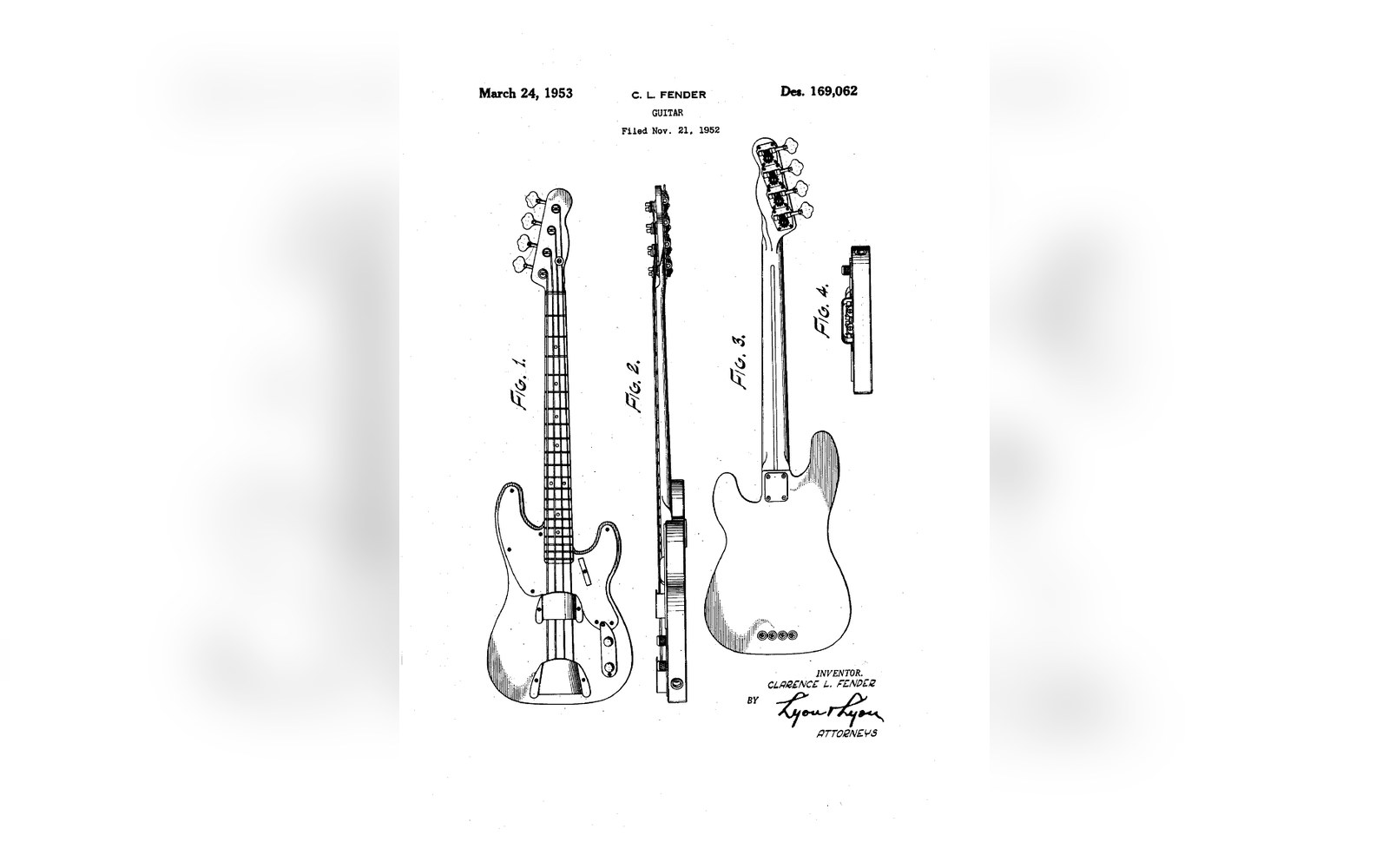
Leo Fender's design patent, filed in 1952. What it draws is the first instrument: square edges, one pickup, a headstock lifted off the Telecaster.
Photo: Fender Precision Bass '51 patent sketch (D169062) · Wikimedia Commons
Electrical recording, introduced commercially around 1925, changed the microphone's sensitivity to lower frequencies and reduced the acoustic bias toward brass. By the late 1920s the double bass had largely displaced the tuba in small jazz combos. The reasons were musical as much as technical: the bass could be bowed or plucked, it could follow a chord change with more harmonic nuance than a valved brass instrument, and it blended with piano and drums in a way that served the emerging swing vocabulary. The tuba survived in some Dixieland and novelty contexts, but by 1930 the double bass was the default.
Swing, Size and the Problem of Physics
Big band swing in the 1930s put the double bass in front of the largest popular audiences American music had seen. Benny Goodman, Count Basie, Duke Ellington — their bands carried a bassist who plucked through arrangements for rooms holding hundreds of dancers. The bass player stood at the back of the rhythm section, head-level with the instrument, right hand pulling gut strings against a tall fingerboard, the body of the bass acting as an acoustic resonator.
The instrument worked. But it presented problems that nobody had yet thought to solve with electronics. The standard orchestral double bass stood roughly six feet tall from scroll to end-pin, weighed upward of twenty pounds, and required a separate vehicle or a taxi willing to accommodate it. Transportation was a recurring cost and a recurring anxiety. In the working musician's life — late-night club dates, touring, one-nighters strung across a region — the bass was something to be managed as much as played.
Amplification existed by the mid-1930s. Charlie Christian was demonstrating what a pickup and a small amplifier could do for a guitar by 1939. Some bassists experimented with contact microphones and early pickups mounted to double basses, with unreliable results — the acoustic body of the instrument introduced feedback, and the low frequencies that defined the instrument's purpose were exactly the ones most likely to cause it. The amplified upright never fully solved its own physics.
Gibson's Electric Bass, introduced in 1938, attempted a different solution: a compact electric instrument with upright-style construction, played vertically. It did not sell in significant numbers. The market for a more playable, transportable bass existed somewhere in the distance, but the design thinking required to reach it had not yet arrived.
Charlie Christian was demonstrating what a pickup and a small amplifier could do for a guitar by 1939.
What Leo Fender Was Actually Solving
Leo Fender was not a musician. He was a radio repairman and electronics tinkerer operating out of Fullerton, California, a city in Orange County southeast of Los Angeles that had no particular claim to musical history. What he brought to instrument design was a manufacturing sensibility: the conviction that the right shape for a part was the shape a machine could cut consistently, and that a tool should be serviceable, not precious.
His Precision Bass — the name referred to the fretted fingerboard, which allowed a player to hit a note with the precision that frets enforce, unlike the unmarked fingerboard of the double bass — arrived in 1951 as U.S. Patent 2,573,254, a solidbody instrument with a single pickup, a bolt-on neck, and a body profile derived from the Telecaster guitar that Fender had already put into production. It was thirty-four inches from nut to bridge, a scale length chosen to approximate the speaking length of the double bass's lowest string while fitting the instrument into a case the size of a guitar case.
That detail — the case — carried most of the argument. A bassist could check a Precision Bass as luggage on a Greyhound bus. They could lean it in the corner of a dressing room. They could play it through whatever amplifier was already on the stage. The acoustic double bass was not replaced because it sounded worse; in many contexts it sounded better, and players who had spent years developing their technique on the upright did not abandon that investment lightly. The Precision was adopted because it made the low-end job survivable for working musicians on compressed budgets and punishing schedules.

Right-hand position sets the tone before any amplifier does: over the pickup is round and thick, back at the bridge is hard and nasal.
Photo: ANTONI SHKRABA production / Pexels
The pickup — a single-coil design mounted to a simple metal plate, straightforward and somewhat noisy by later standards — converted string vibration to signal. That signal went to an amplifier. The Ampeg company would eventually build the amplifiers that became the studio and stage standard; in 1951 the infrastructure was still being invented alongside the instrument. But the principle was established: the bass line was now an electrical signal, subject to all the control, manipulation and amplification that electricity permits. Sixty years of recorded low end stretching from Motown to hip-hop production runs on a direct line from that patent filing.
The tuba's job had been to be loud. The double bass's job had been to be musical and loud enough. The Precision's job was to be louder than either, smaller than either, cheaper to own and easier to replace. It succeeded on all counts, and the double bass became a choice rather than a necessity — which, for serious players, was exactly what made continuing to choose it meaningful.