
When Overdrive Finally Worked Below 200 Hz
Darkglass Electronics was founded in Helsinki in 2010 by Douglas Castro, and within a few years a single pedal — the Microtubes B3K — had established itself as the default tone for modern metal and progressive bass. That sentence sounds like marketing copy, but the evidence is in the credits.
The core problem the B3K solves is one that guitarists never face: overdrive circuits designed for the frequency range of a six-string guitar bleed out when driven by a bass. They thin the low end, bury the fundamental, and leave a fizzy upper-mid smear where the actual note used to be. Castro's design addresses this by splitting the signal. The dry low-frequency content passes through a clean path, preserving the fundamental, while harmonics are generated on the upper partials and blended back in. The result is a growl that sits on top of a retained low end rather than replacing it — a distinction that recording engineers immediately noticed.
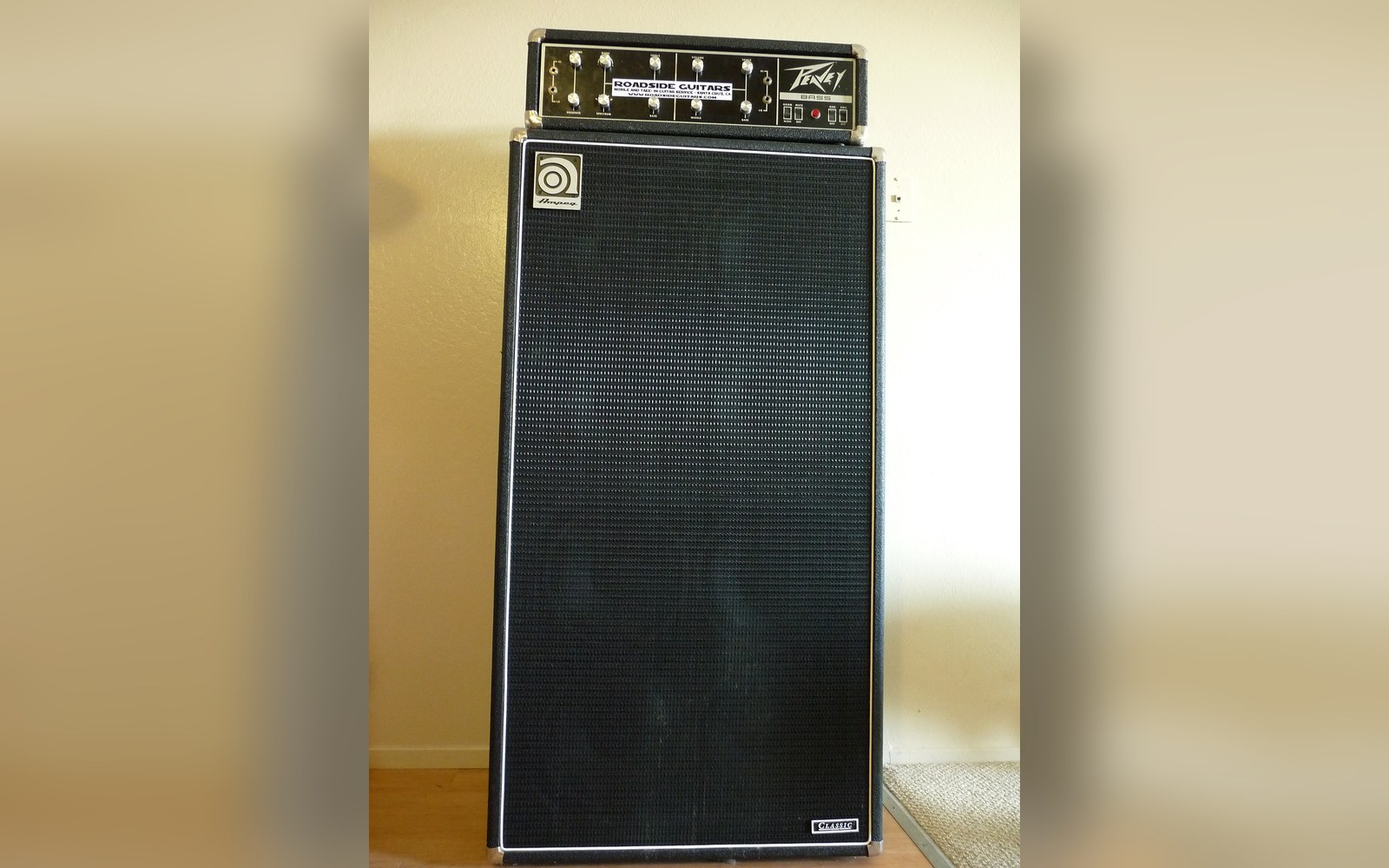
Three hundred valve watts across eight ten-inch speakers. The SVT exists because bass rigs could not keep up with the PA systems of 1969.
Photo: Peavey head & Ampeg Classic cabinet · Wikimedia Commons
The harmonic character the B3K produces is rich in odd-order harmonics, which translate at bass frequencies as a grinding, articulate edge rather than the flabby buzz that most guitar pedals deposit in the same register. The Blend and Drive controls allow a player to dial from clean presence to full saturation while the bass stays planted in the mix. That is not a new idea, but the execution here is precise enough that the B3K's character became recognisable as a specific sound — thick, clanky, defined — rather than a generic distortion.
Studio appearances followed quickly. The pedal turns up in the signal chains of bassists working across progressive metal, modern jazz fusion and film scoring, and Darkglass has been transparent about endorsing players whose recorded work demonstrates the circuit in practice. The company's own documentation and the broader bass community's session reporting consistently tie the B3K to projects where a clean amplifier alone would not carve through dense, downtuned guitar arrangements.
Darkglass has since expanded the line — the Microtubes 900 head integrates the same preamp architecture into a class-D amplifier chassis — but the B3K circuit remains the foundation. That a small Helsinki operation, not a California legacy brand, defined what modern bass overdrive sounds like is its own kind of industry story. The circuit earned its position: not through marketing category but through what happens when a recording engineer pulls up the faders and the bass is simply already there.