Ampeg built one amp for the room and one for the world
Ampeg's two most consequential designs share a lineage and almost nothing else. The B-15 Portaflex, introduced in 1960, is a low-wattage combo built around a single fifteen-inch speaker and a tube preamp that runs warm, compressed and rich in the upper midrange. The SVT — Super Vacuum Tube — arrived in 1969 with six 6550 output tubes, a separate 300-watt head and a cabinet loaded with eight ten-inch speakers. One amp fits in a station wagon. The other filled Woodstock.
The B-15: the sound that needed no room
The Portaflex is a flip-top: the head unit stores inside the cabinet, inverted, and flips up on a hinge to reveal its controls. Mechanically elegant, practically convenient, and — once the amp warms up — sonically precise in a way that belies its modest power rating of around 25 to 30 watts depending on the production year. That restraint is the point. Driven into mild saturation by a bass signal, the tubes colour the tone rather than simply pass it, adding a harmonic density that transistor amplifiers of the same era could not reproduce.
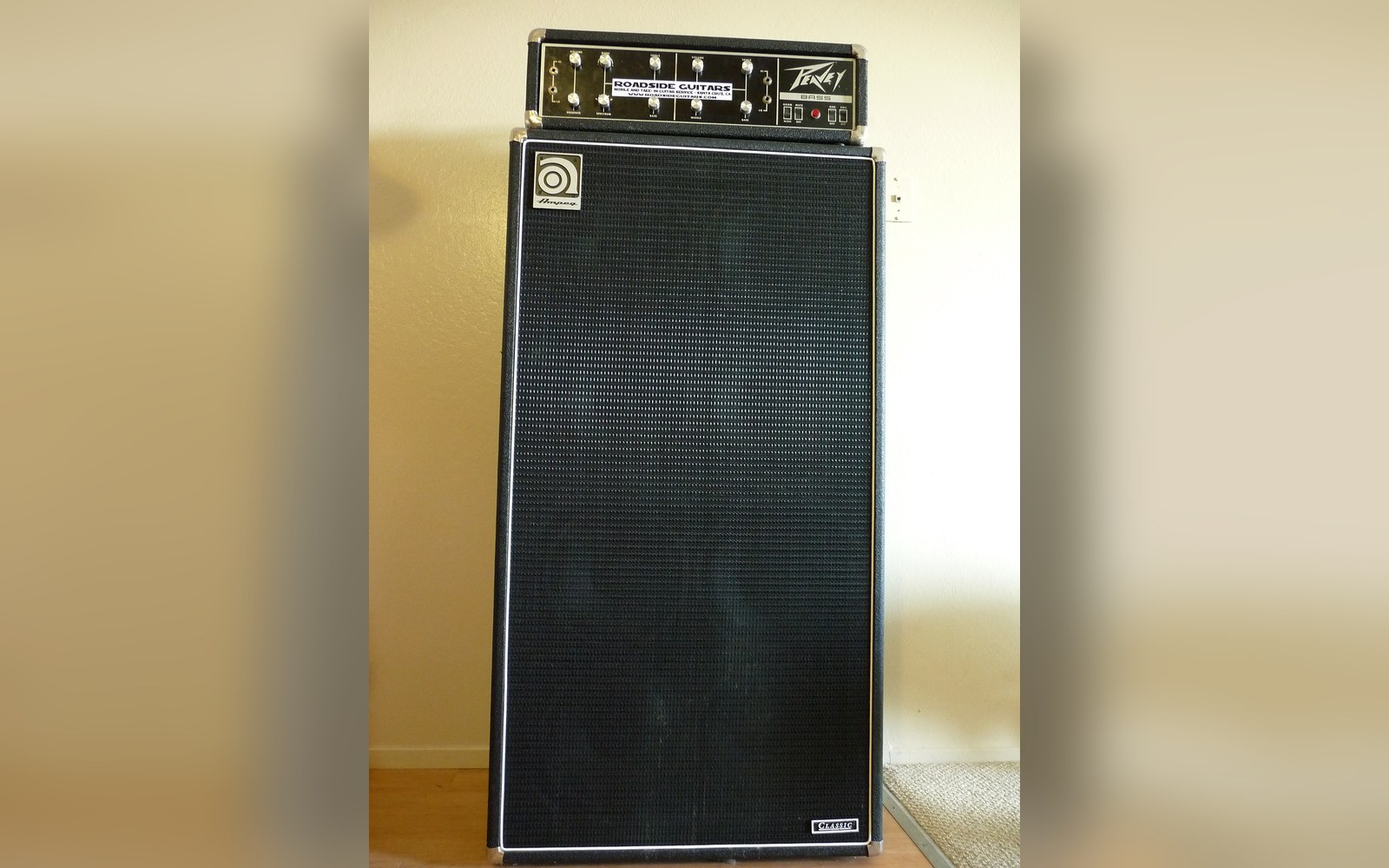
Three hundred valve watts across eight ten-inch speakers. The SVT exists because bass rigs could not keep up with the PA systems of 1969.
Photo: Peavey head & Ampeg Classic cabinet · Wikimedia Commons
James Jamerson recorded the Motown catalogue through a B-15, and its fingerprints are on records from "Bernadette" to "I Was Made to Love Her." The amp sat in Motown Studio A, Detroit, and engineers often ran the signal both direct and through the Portaflex simultaneously, blending the two at the desk. The direct feed sharpened the transient attack; the B-15 supplied everything below it — warmth, body, the sense that the bass occupied physical space. Most listeners have been hearing this combination their entire lives without knowing it had a name.
The circuit itself uses a straightforward single-channel preamp — a single 12AX7 triode stage feeding a tone stack, then the power section — with no active EQ and no onboard effects. The speaker is loaded in a ported enclosure tuned to reinforce the low-mids rather than extend the deepest bass. Flatwound strings and a B-15 produce a tone that sits in a mix without negotiation: present but not aggressive, defined but never harsh. The combination is so consistent that it remains a first-choice option in Abbey Road Studios and comparable facilities for bass recordings requiring a vintage character.
The B-15 was produced in multiple versions — the N, the NF, the NC — through the 1960s and into the 1970s, with circuit changes across generations but the core topology intact. Original units in good condition represent a significant collector and studio market, and Ampeg has reissued the design more than once, most recently as the B-15N Heritage, acknowledging that no solid-state substitute ever fully closed the gap.
The SVT: built on deadline for an outdoor stage
The SVT's origin is specific. In 1969, Ampeg's parent company at the time, Unimusic, pushed for an amplifier capable of operating at full outdoor festival scale without a PA system reinforcing the bass. Bill Hughes and Roger Cox designed the circuit under what Ampeg's own history describes as severe time pressure, with the intent that the amp would debut at Woodstock. It did. The 8×10 cabinet — eight ten-inch Eminence speakers wired in pairs, sealed in individual chambers within the cabinet — disperses sound across a wide vertical array, pushing air in a way a single large speaker cannot match at volume.
The 300-watt tube output stage runs six 6550 pentode valves in push-pull configuration. At that power level, the SVT does not compress gracefully the way the B-15 does; instead it delivers a largely clean, authoritative signal that resists distortion until pushed well beyond what most stages require. The result is a bass tone that remains intelligible at the back of a large room — articulate, physically present, punchy rather than warm. John Entwistle used an SVT. Chris Squire used an SVT. Lemmy Kilmister ran his into overdrive deliberately, using the amp's headroom against itself.
The two circuits represent genuinely different philosophies. The B-15 privileges harmonic texture at manageable volumes; the SVT privileges projection and clarity at extreme ones. Both succeeded completely on their own terms — which is why, more than half a century on, both are still in production.