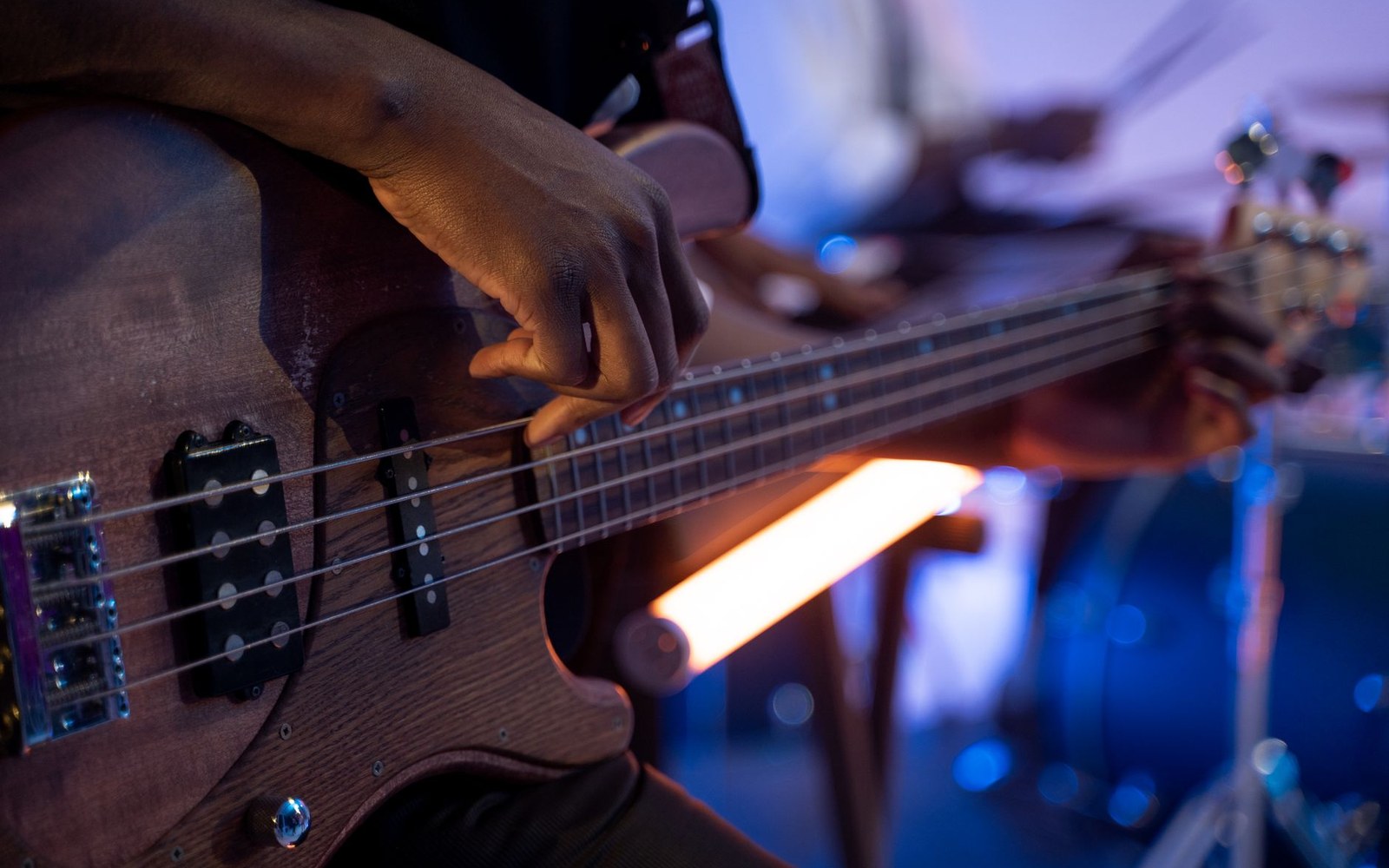
The player who built the low end of a decade without a credit
James Jamerson did not read music in the conventional sense, not at sessions. He heard a chord chart, heard what the track needed, and played — usually in one take, usually standing, always with the index finger of his right hand, which he called the Hook. The left hand handled the neck. The right hand, one finger, produced the lines. That fact alone is enough to stop a working bassist in their tracks, because the lines were not simple.
Jamerson came to Motown from the Detroit upright bass circuit. He had played jazz, worked clubs, developed an improvisational fluency that did not disappear when he moved to the electric instrument — it transferred. The technique he built on the upright carried directly into Motown Studio A, and the lines he played on the Precision Bass retained the rhythmic vocabulary of someone who had spent years negotiating chord changes in real time, in front of a live audience, without a net.
The instrument and the strings
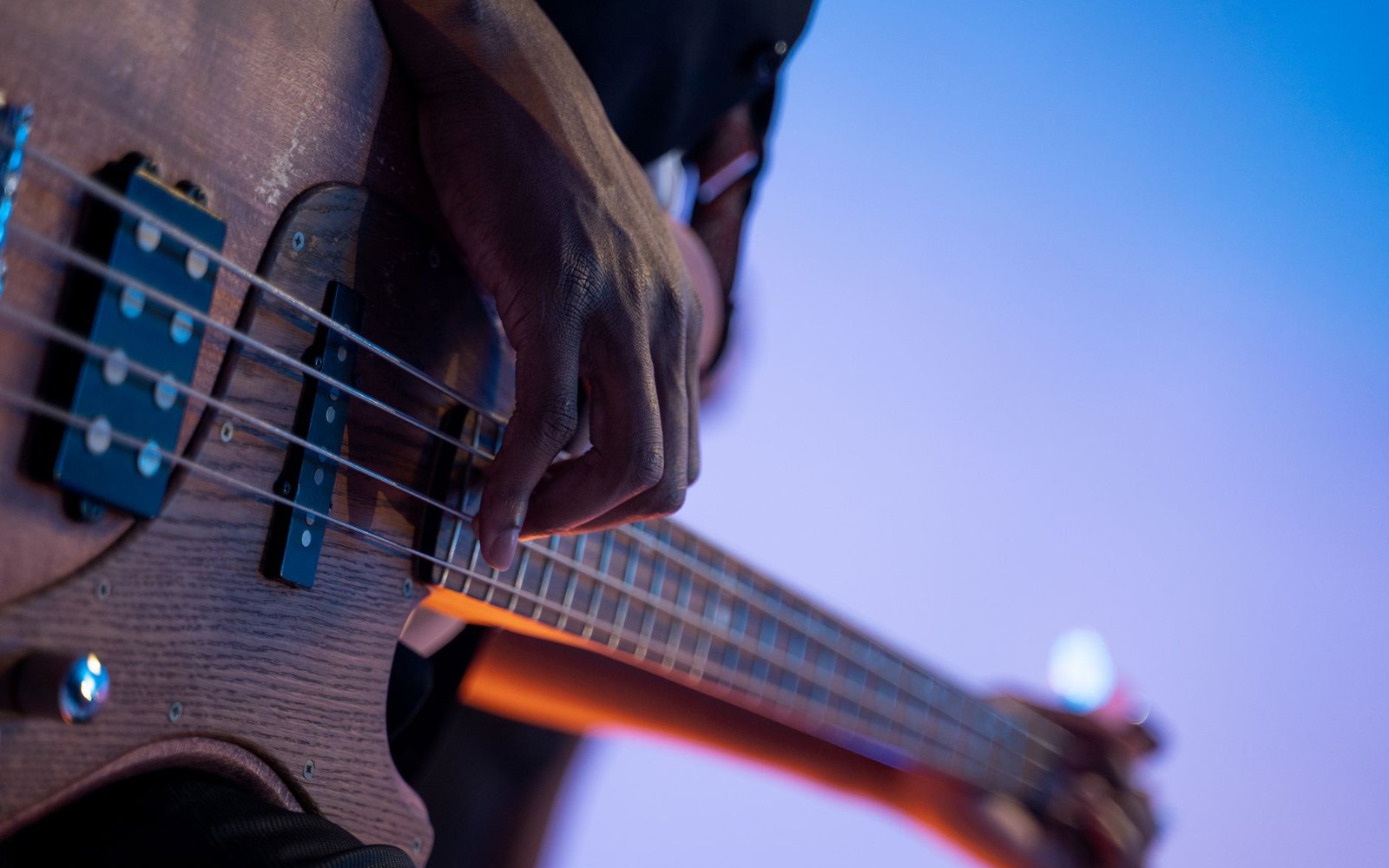
Right-hand position sets the tone before any amplifier does: over the pickup is round and thick, back at the bridge is hard and nasal.
Photo: ANTONI SHKRABA production / Pexels
The bass was a 1962 Fender Precision — sunburst finish, maple neck, rosewood fingerboard. Jamerson strung it with La Bella flatwound strings and, by most accounts of the Funk Brothers who worked alongside him, he was extraordinarily reluctant to change them. The strings on that instrument during the height of the Motown run — roughly 1963 through 1968 — had accumulated years of oxidation, skin oil, rosin residue from his upright playing days and whatever else a working musician's hands leave behind. The mass and compliance of those old flats, loosened by time, is not a footnote; it is an acoustic fact embedded in the recordings. The low end sits differently than it would on fresh strings. It blooms rather than punches. It speaks a fraction of a second after a newer string would, and that slight softness is part of why those bass lines feel inevitable rather than aggressive.
The split-coil pickup in that 1962 Precision — the revised design Leo Fender had introduced five years earlier — gave Jamerson a warm, mid-forward tone that the Motown engineers then ran directly into the board. Studio A's engineers were routing bass signals straight to the console before the practice had a name, capturing a signal that owed nothing to speaker coloration: close, immediate, and locked in the center of the image.
What the lines actually do
Jamerson's bass lines are melodic in the most literal sense — they have contour, surprise, and harmonic logic. They occupy the low end without merely doubling the root on the beat. On tracks like Marvin Gaye's "What's Going On," the bass moves almost continuously; it anticipates changes, implies passing tones, and creates momentum that the rhythm guitar and percussion ride rather than drive. On "Bernadette" by the Four Tops, the line is more aggressive — a repeated rhythmic figure that becomes insistent, almost threatening, under a melody that is asking a question. On the Supremes sessions, it settles and supports; on Stevie Wonder's early recordings, it dances.
The common element is rhythmic density. Jamerson subdivided beats in ways that were unusual for pop bass in the early 1960s, borrowing from jazz and gospel phrasing, embedding sixteenth-note runs and chromatic approaches in contexts where most players would have held a quarter note. He did this not to show off — session musicians in that environment had no forum for showing off, and no reason to — but because that was what the track required and he heard it immediately. The Funk Brothers as a collective were generating an enormous amount of rhythmic and harmonic information in a small room, and Jamerson's bass was simultaneously anchoring the harmony, pushing the rhythm and adding melodic interest in the register just above the kick drum.
The session context and the uncredited years
The Funk Brothers were Motown's in-house session band, working Studio A on West Grand Boulevard in Detroit through the label's classic period. They were not salaried in any straightforward sense; they were paid per session, kept available, and expected to produce usable takes quickly. Jamerson was central to that operation — not merely prominent in it, but structurally essential. The bass parts on the Motown catalogue are not interchangeable. They are composed, in the way that any piece of music is composed when every note reflects a specific musical intention.
None of this appeared on the labels. Motown Records, like nearly all the major labels of the 1960s, did not credit session musicians on commercial releases. The artists named on the record were the singers. The people who made the sonic environment those singers inhabited were contractually bound to anonymity, paid and thanked privately if at all. Jamerson's name was not widely known outside Detroit's working music community until Allan "Dr. Licks" Slutsky's 1989 book Standing in the Shadows of Motown reconstructed the catalogue attribution session by session. The book, and the 2002 documentary of the same name, gave a general audience the first coherent account of what Jamerson had actually played and when.
By then, Jamerson had died. He died in 1983 in Los Angeles, where he had relocated after Motown moved its operations to California, struggling to find consistent session work in a changed industry. He was forty-seven years old.
Jamerson's bass lines are melodic in the most literal sense — they have contour, surprise, and harmonic logic.
The question of influence and audibility
Most people who have heard popular music made between 1963 and 1972 have heard James Jamerson, without knowing it. The influence extends further. Paul McCartney, speaking in multiple interviews about his development as a bassist, identified Jamerson as a primary reference. Flea, Marcus Miller, Pino Palladino — bass players who came of age in entirely different contexts and genres — name him consistently. Jamerson was inducted into the Rock and Roll Hall of Fame in 2000 as a sideman inductee, a category created in part to address exactly this kind of systematic omission.
The whereabouts of the 1962 Precision are generally reported as unknown. The flatwounds, presumably, are long gone — though any honest account of that instrument would note that the strings were as much a part of the instrument as the wood and the pickup. Jamerson was not precious about the bass as an object. He was precise about it as a sound-producing tool, and the sound it produced, in that room, through those strings, with one finger, is still the benchmark.