
Why the Impedance Has to Change
A bass guitar puts out a high-impedance, unbalanced signal. A mixing console wants a low-impedance, balanced one. Run the instrument straight into the desk without converting it and the signal degrades over cable length, picks up hum and loses high-frequency content before it reaches tape or digital. A DI box — direct injection box — performs that conversion in a package roughly the size of a deck of cards.
Two circuit approaches exist. A transformer-based passive DI uses a wound coil to match impedance and requires no power; it handles extreme signal levels gracefully and introduces a subtle harmonic coloration that many engineers consider flattering. An active DI uses an internal circuit, typically battery- or phantom-powered, to buffer the signal before transformation, preserving the full frequency response of the instrument with less coloration and greater headroom control.
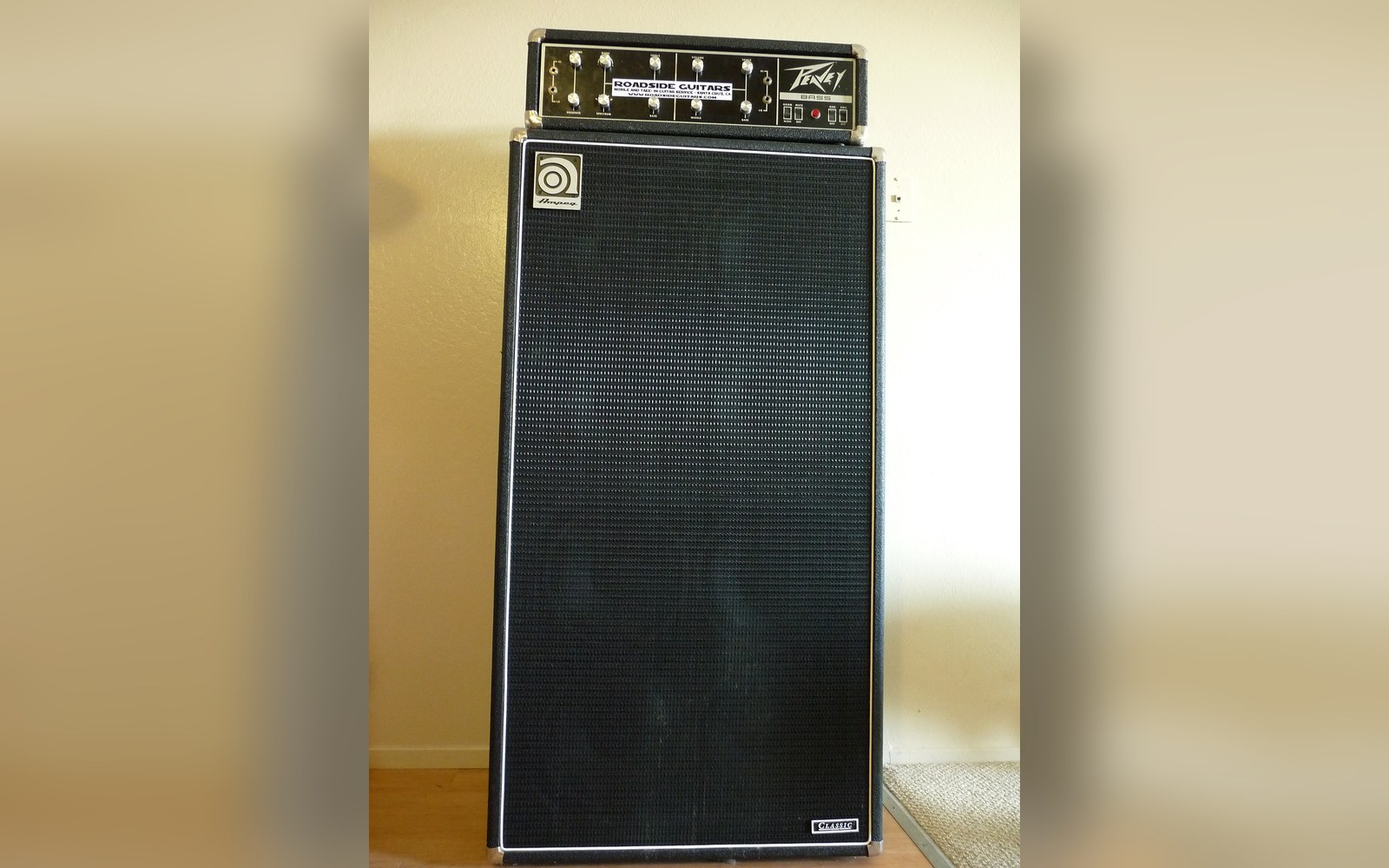
Three hundred valve watts across eight ten-inch speakers. The SVT exists because bass rigs could not keep up with the PA systems of 1969.
Photo: Peavey head & Ampeg Classic cabinet · Wikimedia Commons
The Countryman Type 85, introduced by Countryman Associates in the mid-1980s, is an active design that has become the de facto studio reference for direct bass. Its frequency response is specified flat from 10 Hz to 50 kHz — far beyond what any speaker or human ear resolves, but meaningful in the recording chain because it places no audible fingerprint on the source. The input impedance is high enough that it does not load a passive bass pickup, preserving the instrument's natural tone rather than the tone the pickup makes when it feels a burden.
The Type 85's presence on major-label sessions over four decades has less to do with marketing than with consistency under pressure: it handles the signal swing of a slapped Fender Jazz and the low-level output of a vintage Precision with equal composure. Engineers who move between rooms carry it because it eliminates one variable. That predictability — not glamour — is why it appears on professional recording logs alongside the Ampeg B-15 rather than instead of it.
The DI and the amplifier are not rivals. The microphone on the cabinet captures the room and the speaker's character; the direct signal captures the string. Most bass tracks on records you know are a blend of both.