The Instrument and What Was Done to It
Jaco Pastorius acquired the 1962 Fender Jazz Bass sometime in the early 1970s, when vintage instruments were still working tools rather than collectibles. The neck was a slab-rosewood fingerboard — the briefly produced early-sixties design in which a thin veneer of rosewood was replaced by a thicker, unbound slab glued directly to the maple neck blank. That construction gave the board a particular density and sustain that Jaco valued enough to use as his primary instrument for the rest of his career.
The defret job was, by his own account, crude in method and precise in intent. He pried the frets out with a butter knife — or a similar improvised tool, depending on which retelling you follow — filled the slots with wood filler, and then coated the entire fingerboard with Petite's Poly-Poxy, a two-part marine epoxy sold for sealing boat hulls. The epoxy hardened the surface against the string wear that fretless rosewood cannot long resist under roundwound strings, and it gave the board a glassy reflectivity that contributed to his tone — bright, harmonically dense, almost vocal in the upper register — as much as his right-hand technique did.
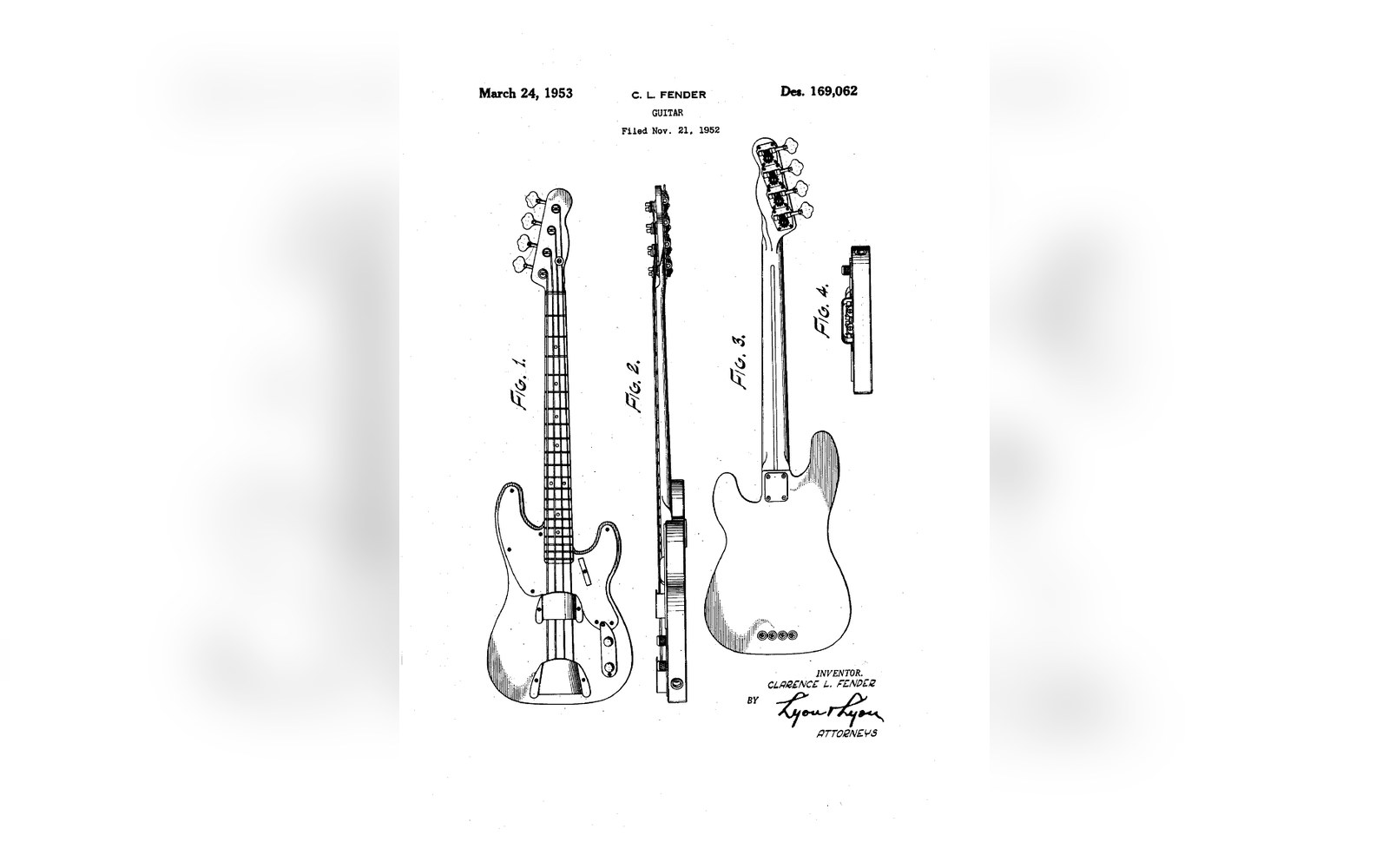
Leo Fender's design patent, filed in 1952. What it draws is the first instrument: square edges, one pickup, a headstock lifted off the Telecaster.
Photo: Fender Precision Bass '51 patent sketch (D169062) · Wikimedia Commons
The body is a sunburst alder Jazz Bass of the period, with the offset waist and dual single-coil pickups that define the design. By the time Jaco had the instrument for a decade, the finish had worn heavily, several components had been replaced more than once, and the epoxy had been reapplied at least once. The instrument looked its age and then some — hence the nickname, which Jaco himself used, though its exact origin is informal and undocumented.
The Recordings It Is On
The Bass of Doom appears on Jaco's 1976 self-titled debut album — recorded when he was twenty-four — and across the Weather Report catalogue from Heavy Weather (1977) onward. "Teen Town," "Havona," "Birdland": all of that low-end melodic lead, the harmonics, the ballistic fast passages in the upper register, came from this one instrument. It is on Joni Mitchell's Hejira (1976) and Don Juan's Reckless Daughter (1977). It played on sessions for Pat Metheny, Paul Bley and others. No other single bass guitar appears on a comparable concentration of influential late-seventies recordings.
What the Bass of Doom required of its player was intonation entirely dependent on the left hand. A fretted instrument places each note with a metal wire; fretless intonation lives in the fingertip's exact placement on the board. A fraction of a millimetre flat or sharp is audible, particularly in a studio context where the bass sits isolated in the mix. Jaco's intonation was, by every recorded measure, exact — not approximate, not approximate-enough, but exact — and it could shift smoothly through microtonal inflections that fretted playing cannot physically produce. The "mwah" of fretless bass — the way a note blooms and decays when the finger presses a string against an unfretted surface — is an artefact of this: the string vibrates against the board itself rather than against metal, creating a chorusing effect in the attack.
Where It Is Now
The Bass of Doom passed through several hands after Jaco's death in 1987, its condition deteriorating further. It was eventually restored — conserved rather than refinished, the distinction matters — and is now held at the Bass Museum of Miami, a city Jaco lived in and returned to repeatedly. The instrument is not pristine; it is not meant to be. The wear on the body, the replaced tuners, the recoated board — these are its history, not damage to be corrected.
What the Bass of Doom demonstrates, sitting in Miami, is something no replica or tribute instrument can fully carry: that one of the most consequential sounds in the history of recorded bass came from a used 1962 Jazz, a butter knife, and a product sold for waterproofing boats. The luthiery was improvised. The music was not.