From Slab to Shape
The 1951 Precision was a working hypothesis. Leo Fender, operating out of Fullerton, California, had solved the right problem — a fretted, electric instrument that let a bassist read the notes clearly and be heard — but the object he built to solve it was austere to the point of severity. The body was a flat ash slab with a single-cutaway profile borrowed, more or less, from a Telecaster. The neck was a one-piece maple bolt-on with a truss rod, which was genuinely new thinking for a bass. The pickup was a single-coil unit sitting beneath a chrome cover. The finish came in blond. It did not look like an instrument that would be mass-produced for the next seventy-plus years. It looked like a prototype, because that is largely what it was.
Between 1951 and 1957, Fender revised the Precision incrementally — a sunburst option arrived, the pickup cover changed shape — but the wholesale rethink came in stages that crystallized around 1957. Three changes arrived in close succession and together they remade the instrument: the body gained contours, the headstock grew wider and more symmetrical, and the pickup became the split-coil humbucker that now defines the Precision sound. Any one of these changes would have been significant. Together they produced a different instrument wearing the same name.
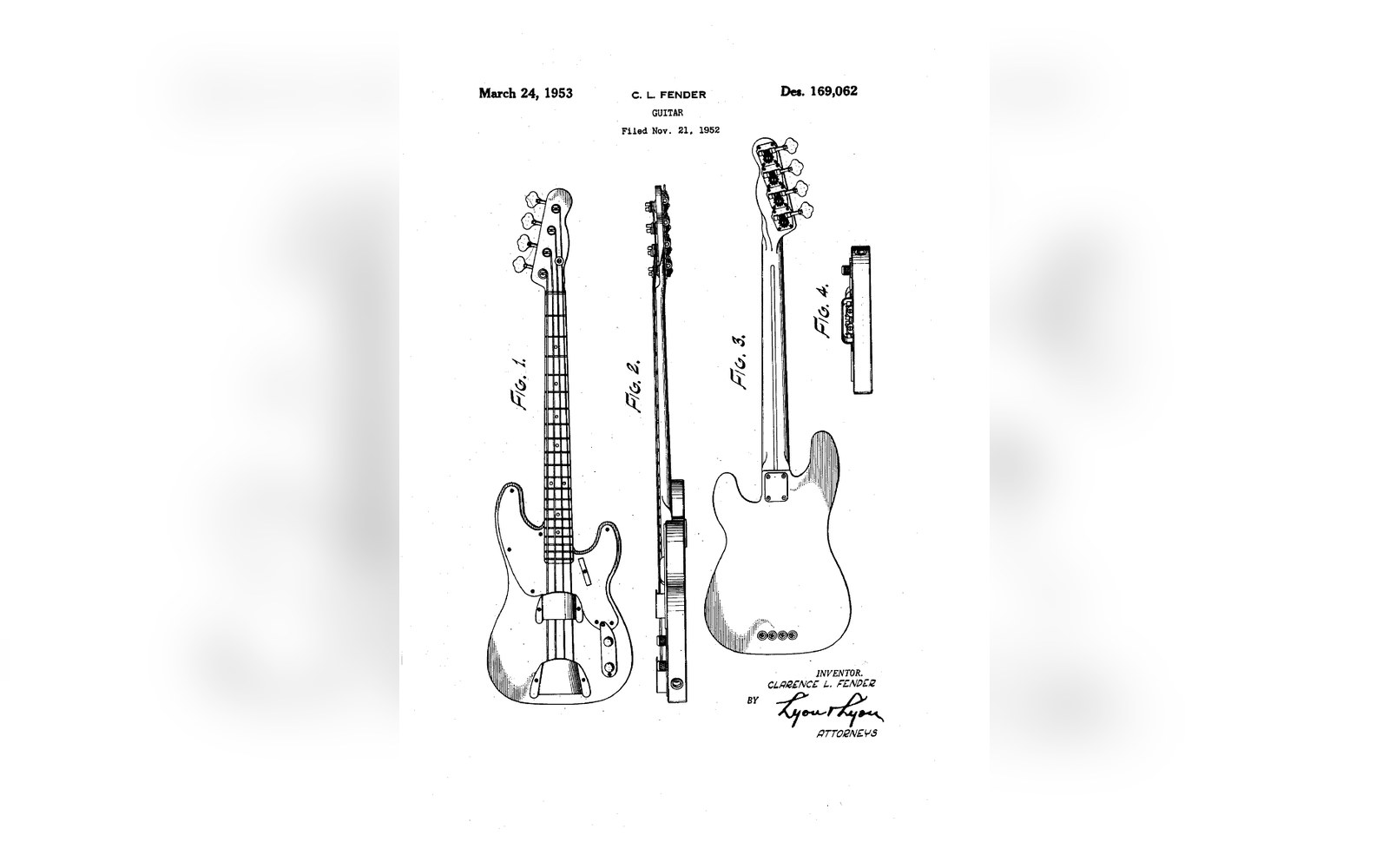
Leo Fender's design patent, filed in 1952. What it draws is the first instrument: square edges, one pickup, a headstock lifted off the Telecaster.
Photo: Fender Precision Bass '51 patent sketch (D169062) · Wikimedia Commons
The contoured body was not cosmetic. A flat slab digs into a player's ribcage and forearm during a three-hour set. The Stratocaster, introduced by Fender in 1954, had already addressed this with carved body bevels, and by 1957 the same logic was applied to the Precision. The forearm contour on the treble-side top and the belly cut on the back transformed what was, in playing terms, a plank into something that sat against the body with purpose. Players noticed immediately. The physical ease of the revised instrument made the 1951 slab feel like a previous era's idea of what a bass guitar might become.
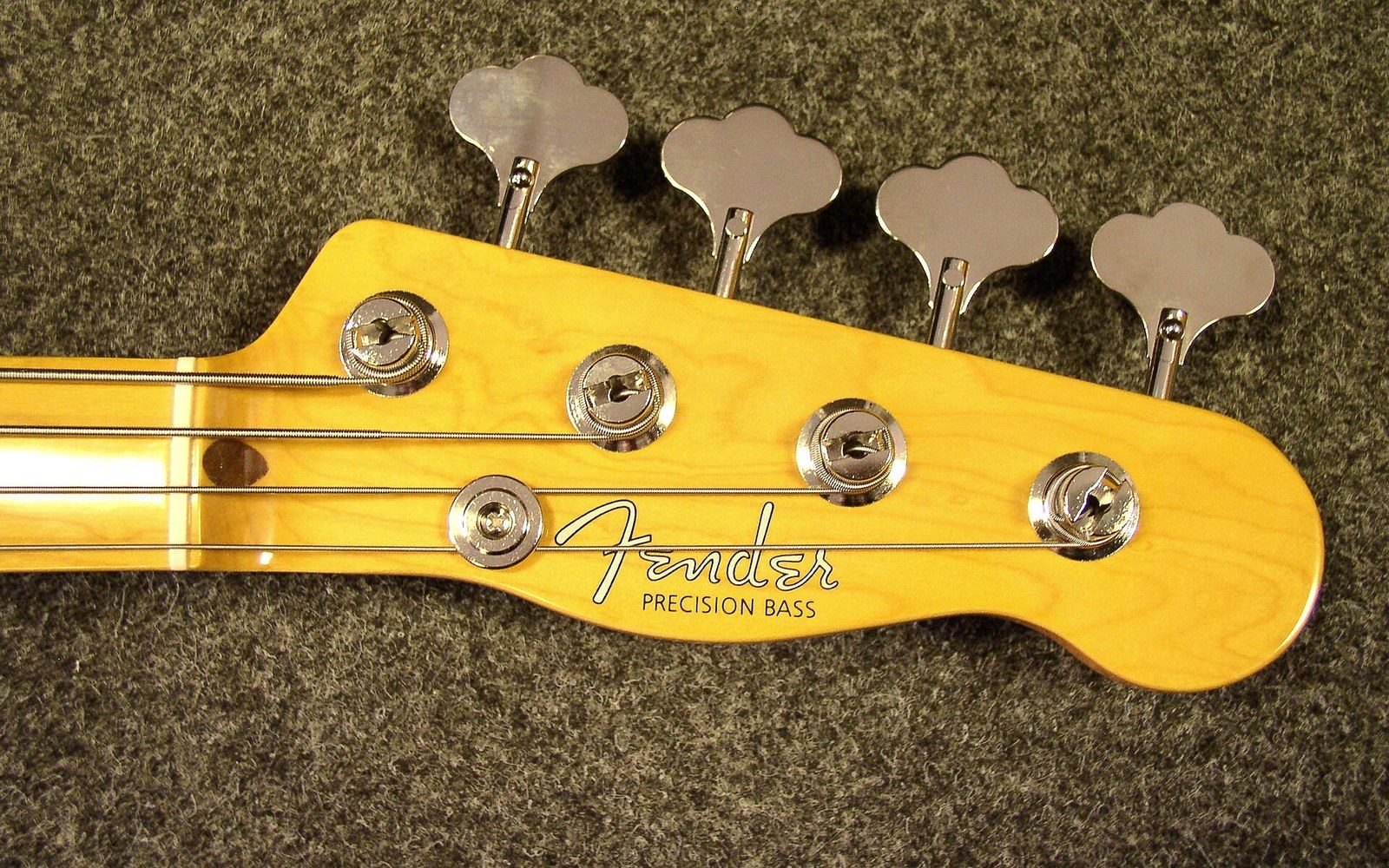
The wider, more symmetrical headstock was partly functional and partly a visual statement. The original four-in-line Precision headstock was narrow and asymmetrical by today's reading; the revised version provided more real estate for tuning machines and gave the instrument a silhouette that read instantly as a bass rather than a converted guitar. That headstock outline became so familiar that manufacturers copying the instrument decades later often reproduced it without thinking about what problem it had originally been designed to solve.
The Pickup That Made the Sound
The split-coil pickup is where the revision moved from ergonomics into acoustics. The original single-coil pickup was prone to mains hum — the 60-Hz electromagnetic interference that plagues single-coil designs in proximity to lighting rigs and other electrical equipment. Fender's solution was elegant: divide the pickup into two coil halves, stagger them along the string path, and assign one to the E and A strings and the other to the D and G. The two coils are wound in opposite directions with opposite magnetic polarity, which means the hum each induces cancels the other's — the same humbucking principle Seth Lover had applied to the Gibson PAF humbucker for guitar in 1955, arrived at by Fender through a different geometry.
The sonic result was not just quieter. The split-coil pickup produced a character of its own: warm in the lower midrange, with a fundamental that punched through a mix without requiring volume to do it. That quality — presence without aggression — is why the split-coil Precision became the instrument James Jamerson carried into Motown Studio A and why it remained the default bass sound in popular recording through the 1960s and well into the 1970s. The pickup did not simply capture the string; it shaped it.
Every major manufacturer that subsequently built a bass with a single split-coil pickup was copying the 1957 revision, not the 1951 original. Gibson's EB series, Yamaha's BB line, Ibanez's long series of Precision-inspired instruments — the template in each case is the revised Fender, the one that had worked out its own initial compromises. According to the Smithsonian's National Museum of American History, the electric bass guitar is represented in its collections as an object that transformed popular music performance; the instrument doing that transforming was the production-refined 1957 version, not the first iteration that preceded it.
There is a useful distinction between an invention and a template.
What the Industry Actually Copied
There is a useful distinction between an invention and a template. The 1951 Precision was the invention — it established that the electric bass guitar was a viable, commercially producible instrument. The 1957 revision was the template — it established what that instrument should feel like, sound like, and look like. These are different contributions, and the historical weight tends to be assigned to the former while the practical legacy belongs entirely to the latter.
When Fender's competitors began entering the bass market in earnest during the 1960s and 1970s, they were working from observation of what players had actually adopted and kept, not from studying the 1951 blueprints. The contoured body was non-negotiable by that point. The split-coil or clearly humbucking-derived pickup was the expected baseline. The general headstock proportions, the bolt-on neck scale of thirty-four inches, the control layout of a single volume and a single tone: all of it derived from an instrument that was itself a correction of an earlier instrument.
Roger Sadowsky, building high-end Precision- and Jazz-inspired instruments in New York from the 1980s onward, was refining the 1957 blueprint further still — adjusting neck profiles, fitting active preamps, improving the shielding and hardware of an already established form. Sheldon Dingwall's fanned-fret instruments departed radically from the headstock and fret geometry while retaining the basic ergonomic and pickup logic the revised Precision had established as standard. Even instruments that deliberately oppose the Precision template — Rickenbacker's neck-through construction and bright, clanging single-coil voice, for instance — define themselves partly in opposition to it.
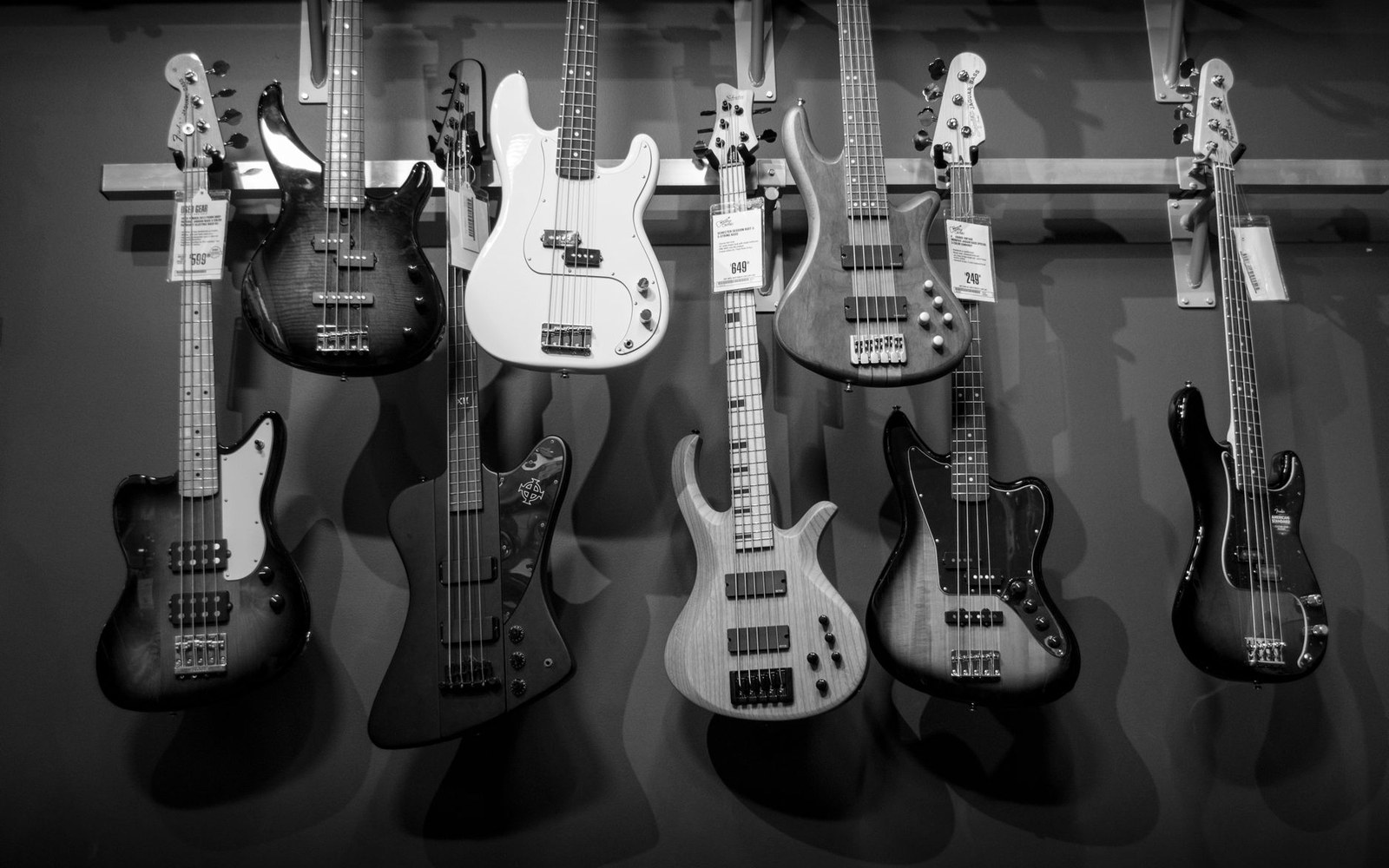
The shop wall used to set the price. Most of that work has moved to second-hand listings and their completed-sale data.
Photo: Stephen Niemeier / Pexels
The Fender Custom Shop has, for decades, offered relic'd and time-capsule versions of both the 1951 and 1957 Precision. The 1951 reproductions sell as historical curiosities, objects of a specific moment. The 1957 reproductions sell as basses, things people intend to play. The market has made its own argument without anyone having to articulate it.
What Leo Fender accomplished between 1951 and 1957 was rarer than invention: he looked at his own successful product with enough detachment to see its actual limitations, and he corrected them completely. The instrument that came out of that process was the one worth copying. The industry agreed.