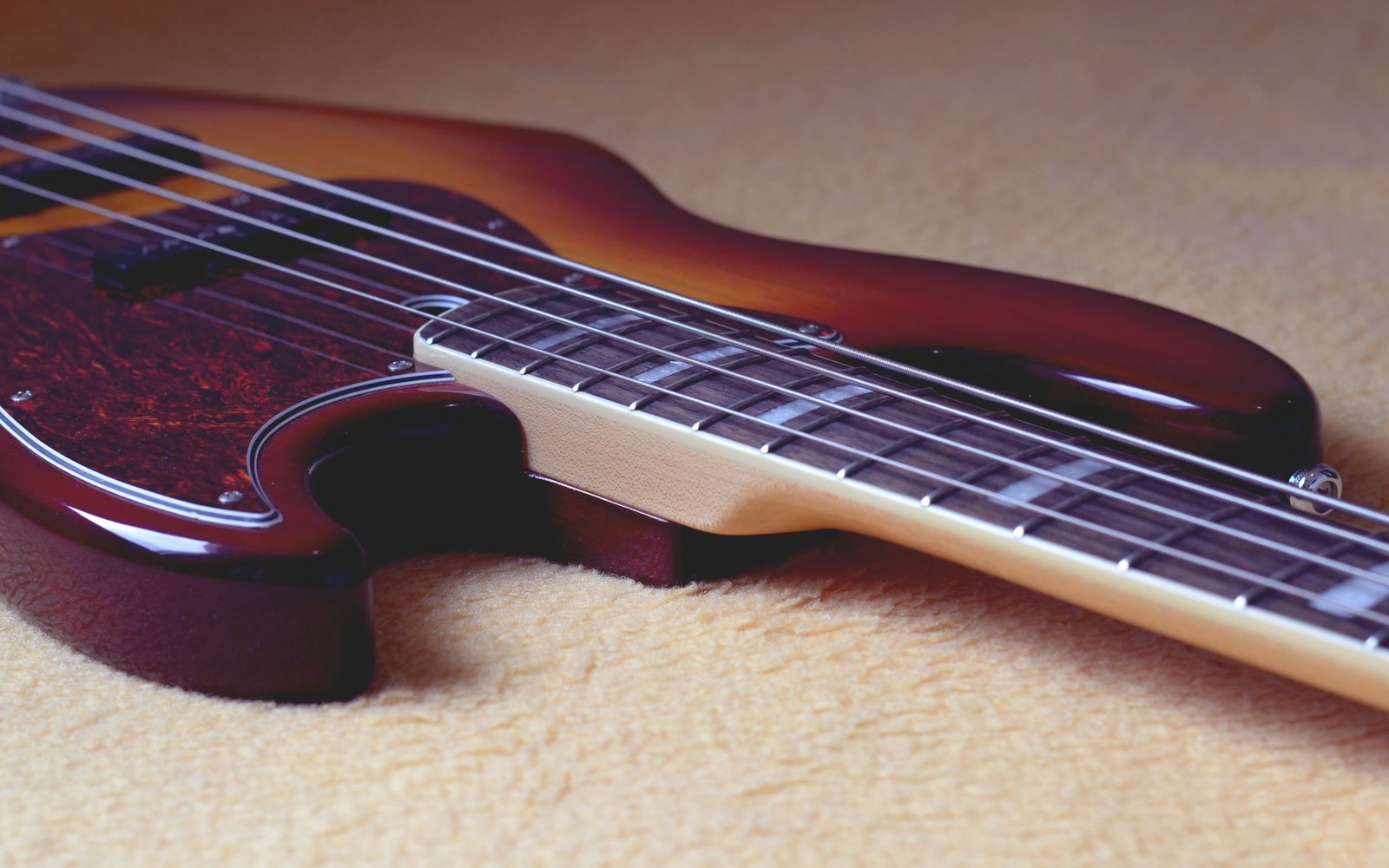
The Construction Underneath
The Rickenbacker 4001 arrived in 1961 as a refinement of the 4000, Rickenbacker International Corporation's first dedicated bass. Its defining characteristic — before you touch a string — is neck-through construction: a central strip of maple runs continuously from headstock to tail block, with walnut body wings glued to either side. There is no neck joint to introduce a break in the transmission of vibration, no bolt plate, no gap. Sustain accumulates differently on a neck-through instrument, rolling forward rather than terminating. That physical fact precedes every tonal choice a player makes.
The 4001 also carried a stereo output — technically a high-fidelity, or "Rick-O-Sound," system that sent the neck and bridge pickups to separate output jacks, allowing each to run to its own amplifier or through its own signal chain. It was a genuinely unusual engineering ambition for a production bass. In practice, most players never used it. Chris Squire of Yes ran a stereo rig that was genuinely biamplified; the majority of Rickenbacker owners simply plugged into the mono jack and left the second socket dark. The system remains on the 4003, the updated model that replaced the 4001 in 1980 and continues in production.
Two Players, One Midrange
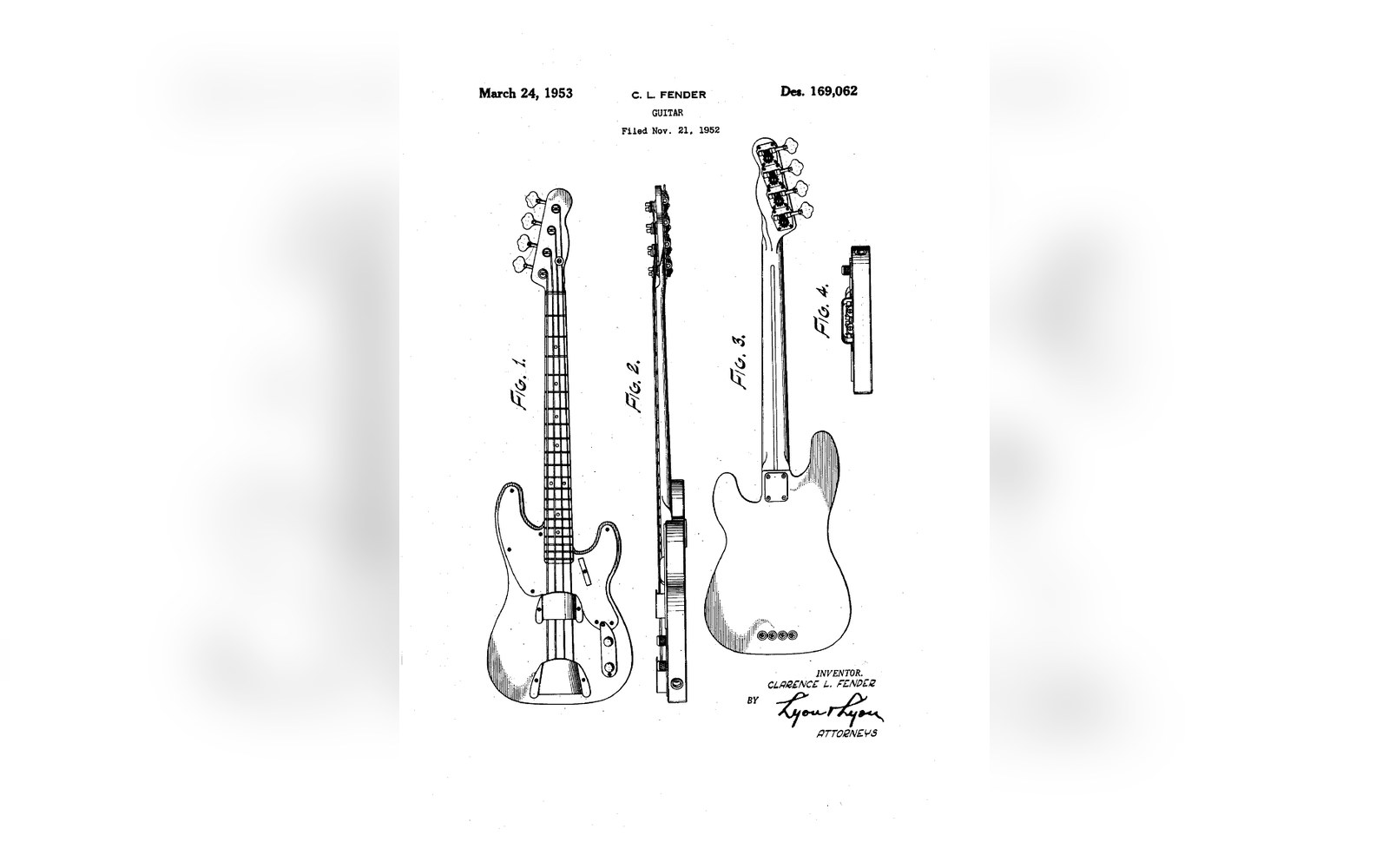
Leo Fender's design patent, filed in 1952. What it draws is the first instrument: square edges, one pickup, a headstock lifted off the Telecaster.
Photo: Fender Precision Bass '51 patent sketch (D169062) · Wikimedia Commons
The Rickenbacker's tonal character — an aggressive, nasal midrange peak, a piano-attack on the high end of each note — is not an accident of the pickup design alone. It follows from the maple-heavy construction driving a bright fundamental, filtered through the instrument's treble-forward electronics, whose tone controls can roll the high frequencies back. But the pickup still does most of the work. The neck pickup, a high-output single-coil in an oblong surround, is the voice most players associate with the instrument's bark.
A pick — hard plastic, nylon or stone — strikes that neck pickup differently than a fingertip. The attack arrives faster, the transient sharper, and the harmonic content above 2 kHz lifts. On a Precision Bass, roundwound strings and a pick together add glitter over a substantial low-mid foundation. On a Rickenbacker, the same combination compresses the low end against an already prominent midrange and produces something close to aggression. That is the sound Chris Squire recorded on Yes's Roundabout in 1971 — a Rickenbacker 4001 through Marshall stacks, the pick scraping enough attack from the neck pickup that the bass could be heard cutting through Steve Howe's guitar as an independent melodic instrument.
Lemmy Kilmister came from the opposite continent of musical intention. His Rickenbacker — he favored the 4001 through most of Motörhead's formative decade — was played with a pick held nearly flat against the strings, raked rather than struck, and run through Marshall amplification cranked well past unity. The result shared the Rickenbacker's signature midrange honk but compressed it into wall-of-noise. Where Squire's pick technique extracted detail, Lemmy's extracted mass. The same construction yielded both sounds because the neck-through body kept the sustain even as the playing style changed what was on top of it.
What the Pickup Actually Does
The 4001's neck pickup sits closer to the fretboard than most comparable instruments, which emphasizes fundamental and lower harmonic content. A pick hit — especially with the instrument's characteristically narrow nut width on older models — forces the string into displacement quickly and releases it just as fast, producing a cleaner, louder initial transient. The pickup reads that event faithfully and the maple body pushes the upper partials forward rather than absorbing them. The preamp does nothing here: the 4001 and 4003 are passive instruments. What you hear is wood, string, plastic and wire, in that sequence.
That sequence, assembled in Santa Ana, California, is still audible on the records it helped make — below the chord, unmistakable, loud.