The 1960 Redesign and What It Was Selling
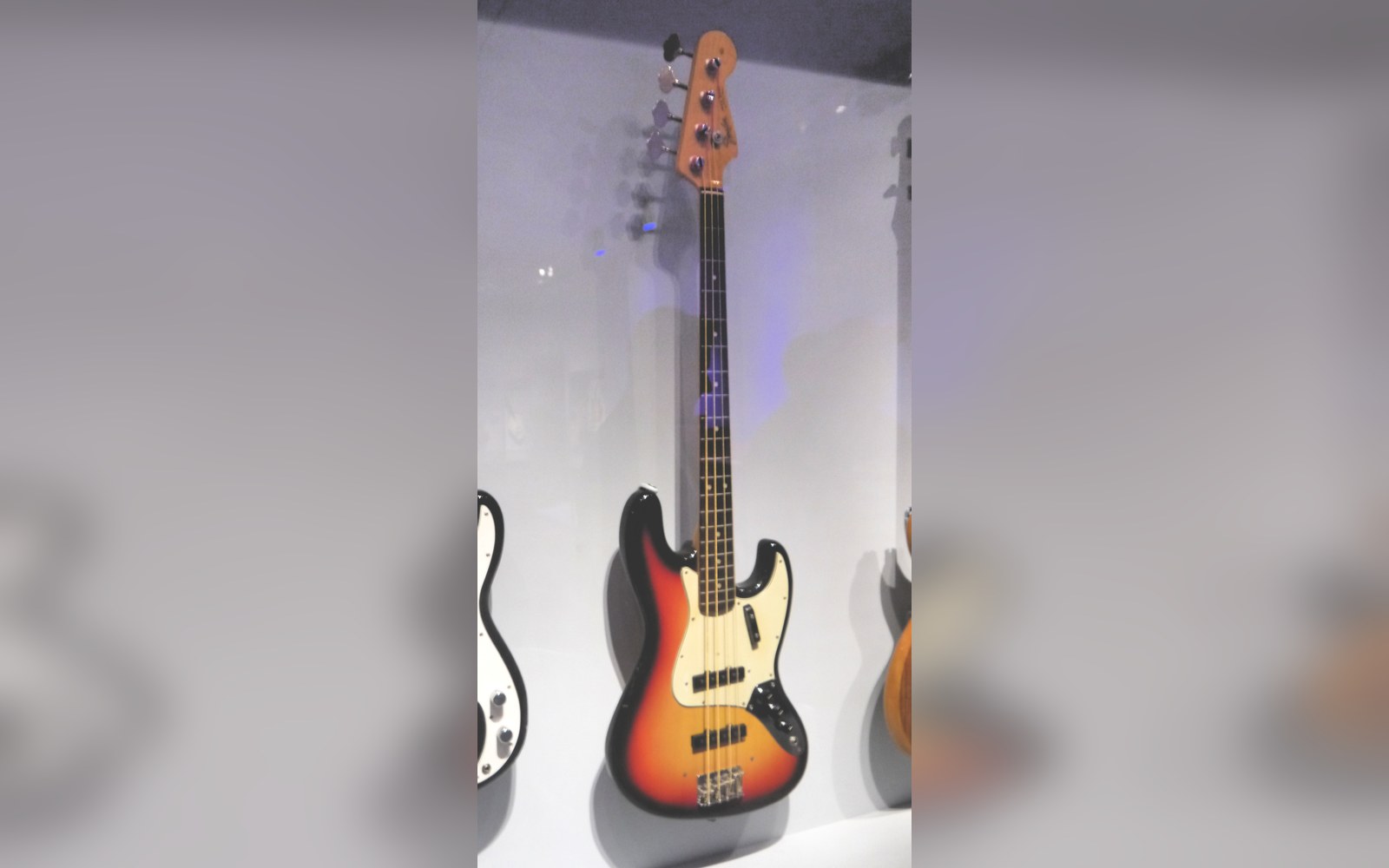
Fender introduced the Jazz Bass in 1960 as an explicit premium instrument, priced higher than the Precision Bass it was meant to sit above. The rationale was visible in the name: a narrower nut width of 1.5 inches against the Precision's 1.75, an offset waist body that balanced differently on a strap, and a second pickup sitting close to the bridge. Fender's pitch was toward upright players and guitarists making the transition — people whose hands expected a slimmer neck profile. The market responded exactly as predicted, and then kept going. Within a decade the Jazz Bass was everywhere: session rooms, touring rigs, recording dates where no one had asked for it specifically and nobody wanted anything else.
The offset body, borrowed conceptually from the Jazzmaster guitar introduced two years earlier, distributed weight differently from the Precision's slab silhouette. Players noticed the taper: the Jazz Bass neck widens from the nut toward the body, giving the fretting hand a narrower first-position grip while still arriving at a comparable width by the heel. It felt like a guitar. It played like one too, at least in the upper register, which mattered to a generation of players arriving from six-string work rather than from upright bass.
What Two Pickups Actually Do
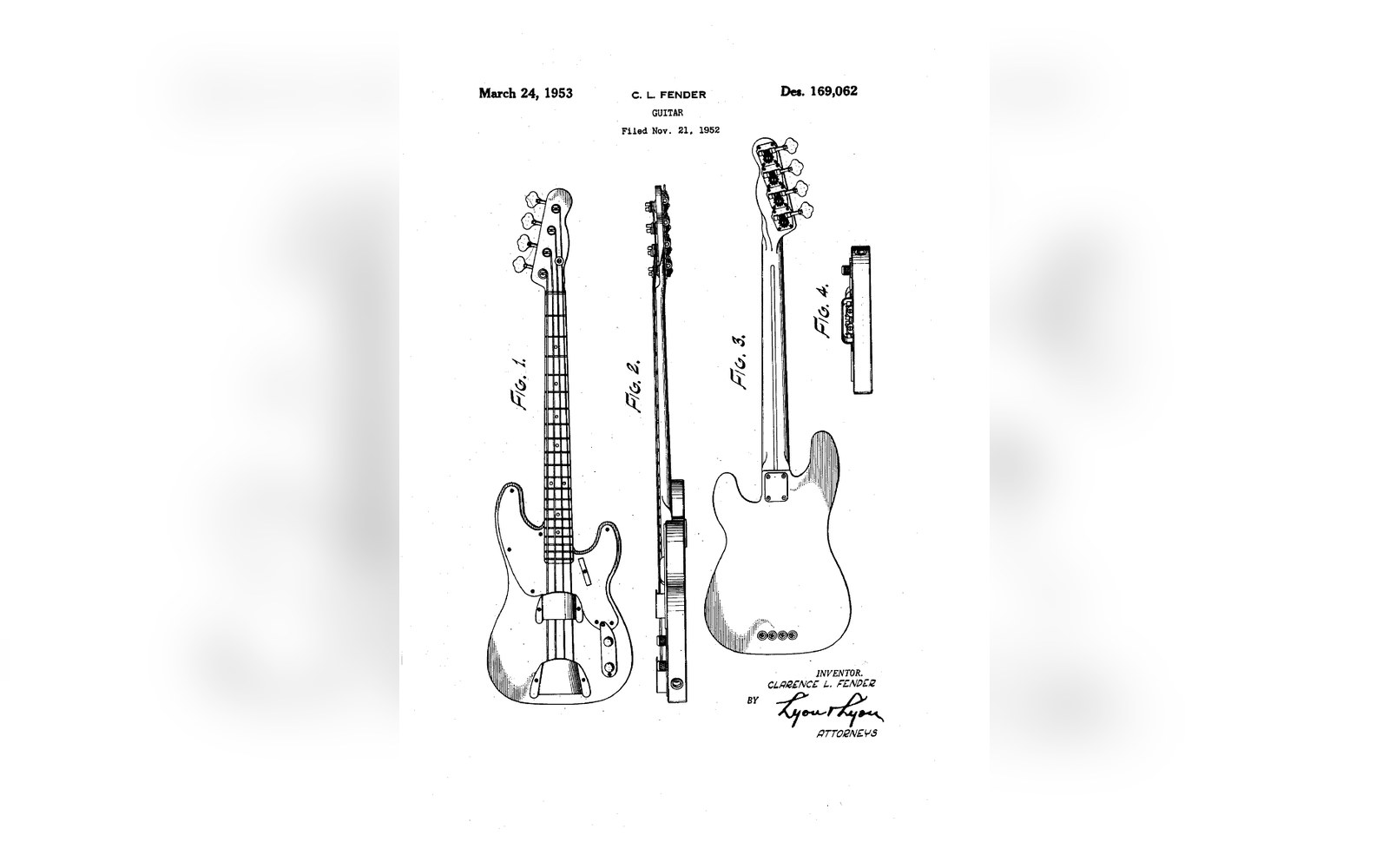
Leo Fender's design patent, filed in 1952. What it draws is the first instrument: square edges, one pickup, a headstock lifted off the Telecaster.
Photo: Fender Precision Bass '51 patent sketch (D169062) · Wikimedia Commons
The dual single-coil configuration is the Jazz Bass's central acoustic argument. Each pickup covers all four strings — one sits near the neck, one near the bridge — and together they operate on different portions of each string's vibration cycle. A string's motion is wider and slower near its midpoint; it narrows and quickens as you approach the bridge. The neck pickup therefore captures a fuller, rounder fundamental. The bridge pickup catches the faster, more complex motion that lives in the upper harmonics.
Run both pickups at full volume and something useful happens: because the two single-coil pickups are hum-cancelling when combined — their coil windings are reverse-wound and reverse-polarity relative to each other — the noise floor drops while the frequency content stacks. The combined signal is not simply louder; it has a scooped midrange character, pronounced low end and cut in the upper-mid range that carves through a dense mix without occupying the harmonic space the guitars need. Pull the bridge pickup back slightly and the midrange returns. Run the bridge pickup alone and the tone sharpens to something almost nasal, useful for funk and for sitting on top of a keyboard-heavy arrangement.
James Jamerson's work at Motown Studio A was almost entirely rooted in Precision tonality, but the Jazz Bass's flexibility at the desk — its responsiveness to DI recording and its wide tonal range without requiring a change of instrument — made it the studio default through the 1970s. Marcus Miller, who became one of the instrument's definitive voices, arrived at the bass through that studio logic: a Jazz Bass could cover the Motown-adjacent warmth needed for a ballad and the percussive bite needed for funk, often within the same session. Jaco Pastorius, who defretted a 1962 Jazz Bass, exploited the bridge-favored pickup position to extract harmonics and sustain that had no precedent in the instrument's design brief.
The dual-pickup system also meant that recording engineers had a workable DI signal without extensive outboard shaping. The instrument's own controls offered a useful if imprecise EQ: stacked concentric pots for volume and tone per pickup in the original 1960 configuration, later replaced by two volume knobs and a single tone control. The Countryman Type 85 and its peers became standard interfaces between Jazz Basses and console inputs precisely because the instrument's output was already well-shaped for tape or digital capture.
The Jazz Bass has remained in continuous production since 1960 — an unusually stable platform in an industry that routinely cycles through revisions. The neck is still the reason players reach for it first.