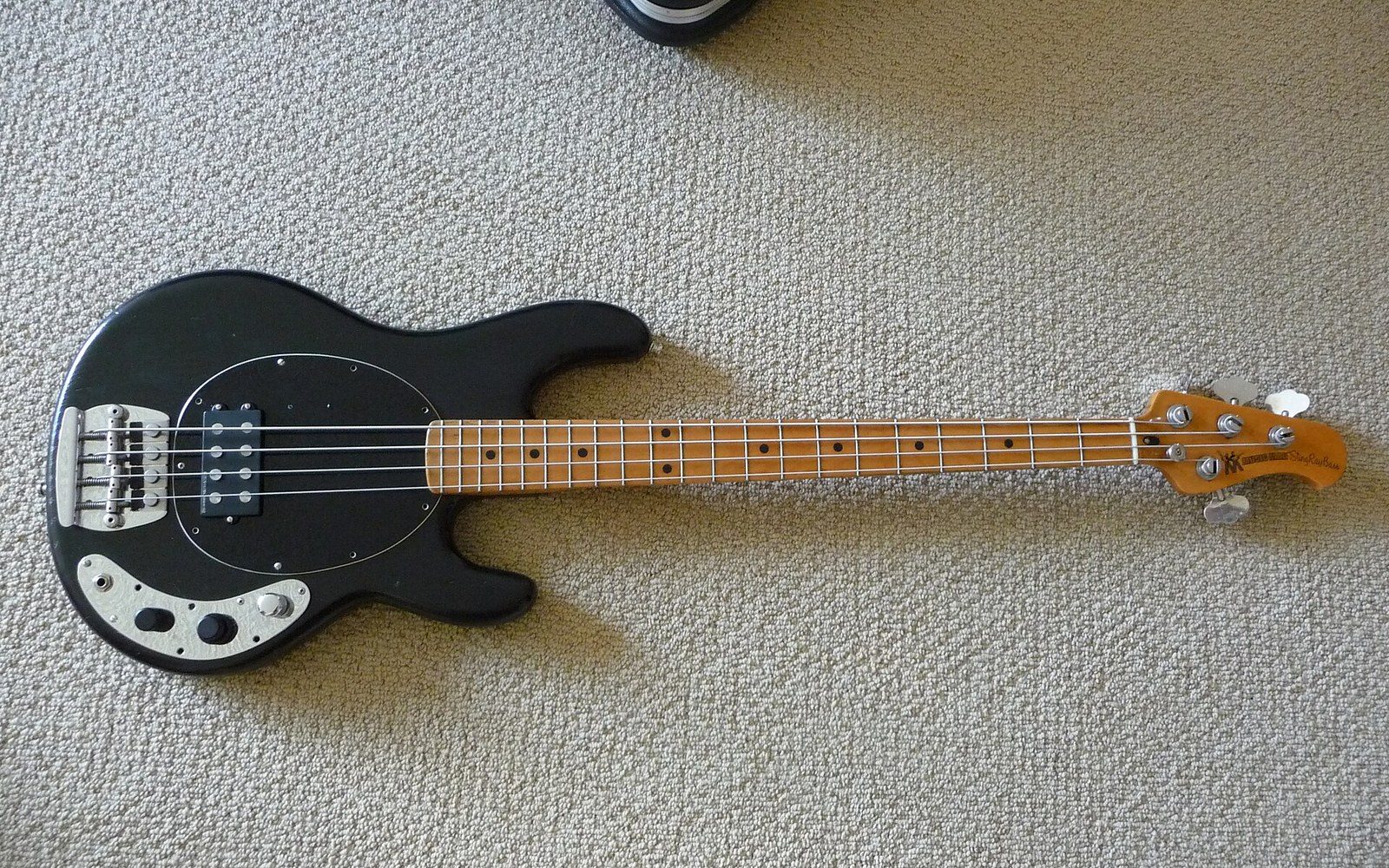
The Second Correction
Leo Fender had already revised his own instrument once. The 1951 Precision Bass was a slab-bodied utilitarian object; the 1957 revision gave it a contoured body, a split-coil pickup and a headstock that became a template for the industry. By the mid-1970s, Fender had sold his original company to CBS, signed a non-compete agreement that ran its course, and was back at work in Fullerton, California — this time under the Music Man name, in partnership with former Fender associates Forrest White and Tom Walker.
The instrument he built there, the StingRay, was not a cosmetic update. It carried a single large humbucking pickup positioned closer to the bridge than anything on a Precision or Jazz Bass — a placement that emphasized upper harmonics and attack. But the more consequential change sat beneath the pickguard: a two-band active preamp, powered by a nine-volt battery, that boosted and shaped the signal before it reached the output jack. This was among the first production basses to carry such a circuit as standard equipment.
What the Preamp Actually Did
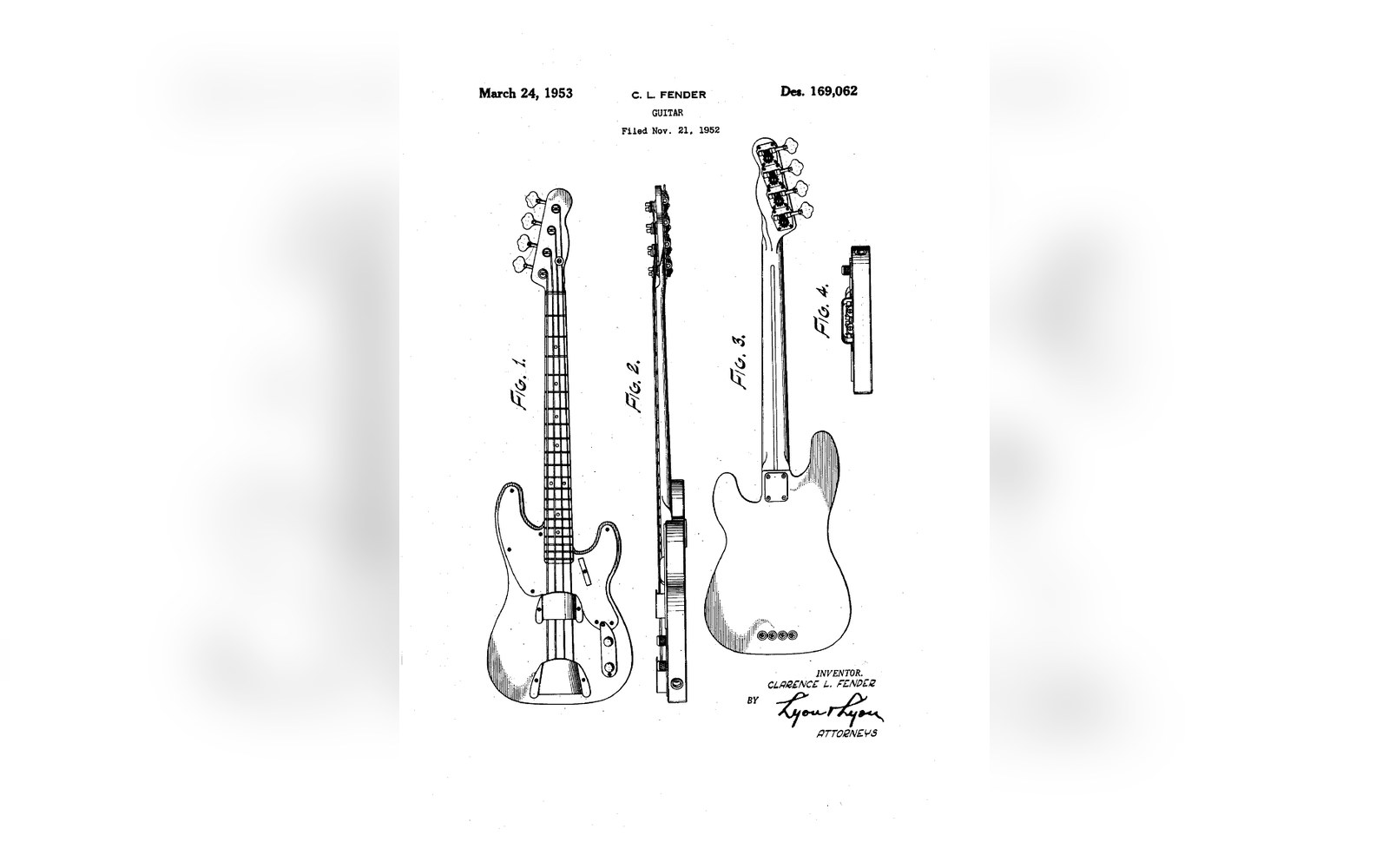
Leo Fender's design patent, filed in 1952. What it draws is the first instrument: square edges, one pickup, a headstock lifted off the Telecaster.
Photo: Fender Precision Bass '51 patent sketch (D169062) · Wikimedia Commons
A passive bass — any Fender product up to that point — sent whatever the pickup captured directly to the amplifier. Tone controls on passive instruments work by cutting frequencies; they can only remove. An active preamp inverts that relationship. The StingRay's onboard circuit, designed with significant input from electronics engineer Tom Walker, offered genuine boost as well as cut across its treble and bass controls. The result was a bass that could speak clearly through a dense mix without the player leaning on the amplifier's EQ or compensating with technique alone.
The sonic signature this produced was unlike anything in the established vocabulary of recorded bass. Where flatwound strings on a Precision delivered a warm, thuddy low-mid presence, and a roundwound Jazz Bass opened up the upper register, the StingRay with its active circuit could do both simultaneously — deep low end with a pronounced top that translated clearly on recorded tracks. Studio engineers noticed quickly. The instrument appeared on funk, pop and R&B sessions through the late 1970s and into the 1980s precisely because it sat in a mix without much assistance.
The humbucking pickup contributed its own character. Two coils wired together to cancel electromagnetic interference produced a fuller, rounder fundamental than a single-coil Jazz pickup, without the mid-forward compression of the Precision's split-coil design. The combination — humbucker plus active boost — gave the StingRay a recognizable voice that has not changed fundamentally in the decades since. Later revisions, including three-band versions, changed the preamp details, but the basic pairing of humbucker and active electronics has remained.
G&L and the End of the Argument
Leo Fender left Music Man in 1979 following disputes with his partners and founded a third company the following year: G&L Musical Instruments, again in Fullerton, with George Fullerton, whose initial appears in the name. G&L continued the active-electronics experiment with instruments like the L-1000 and later the L-2000, refining the preamp topology and offering players multiple pickup configurations with switchable active and passive modes. Fender worked there until his death in 1991.
The G&L instruments never achieved the commercial presence of the StingRay, but they represent the most sustained record of where Leo Fender's thinking had arrived — the construction details of these instruments show the choices he settled on. His final instruments were more complex, more electronically sophisticated and, in some respects, more capable than anything bearing the Fender name on its headstock.
What the StingRay established — the idea that the instrument itself should process its signal, not merely generate it — became the default expectation for a certain category of bass. Every active preamp that followed, from the circuits in high-end boutique instruments to the battery compartment on an entry-level Ibanez, owes its presence on the instrument to the logic Music Man put into production in 1976. Leo Fender had sold one company, outlasted his non-compete, built the argument twice more, and never stopped correcting the record.