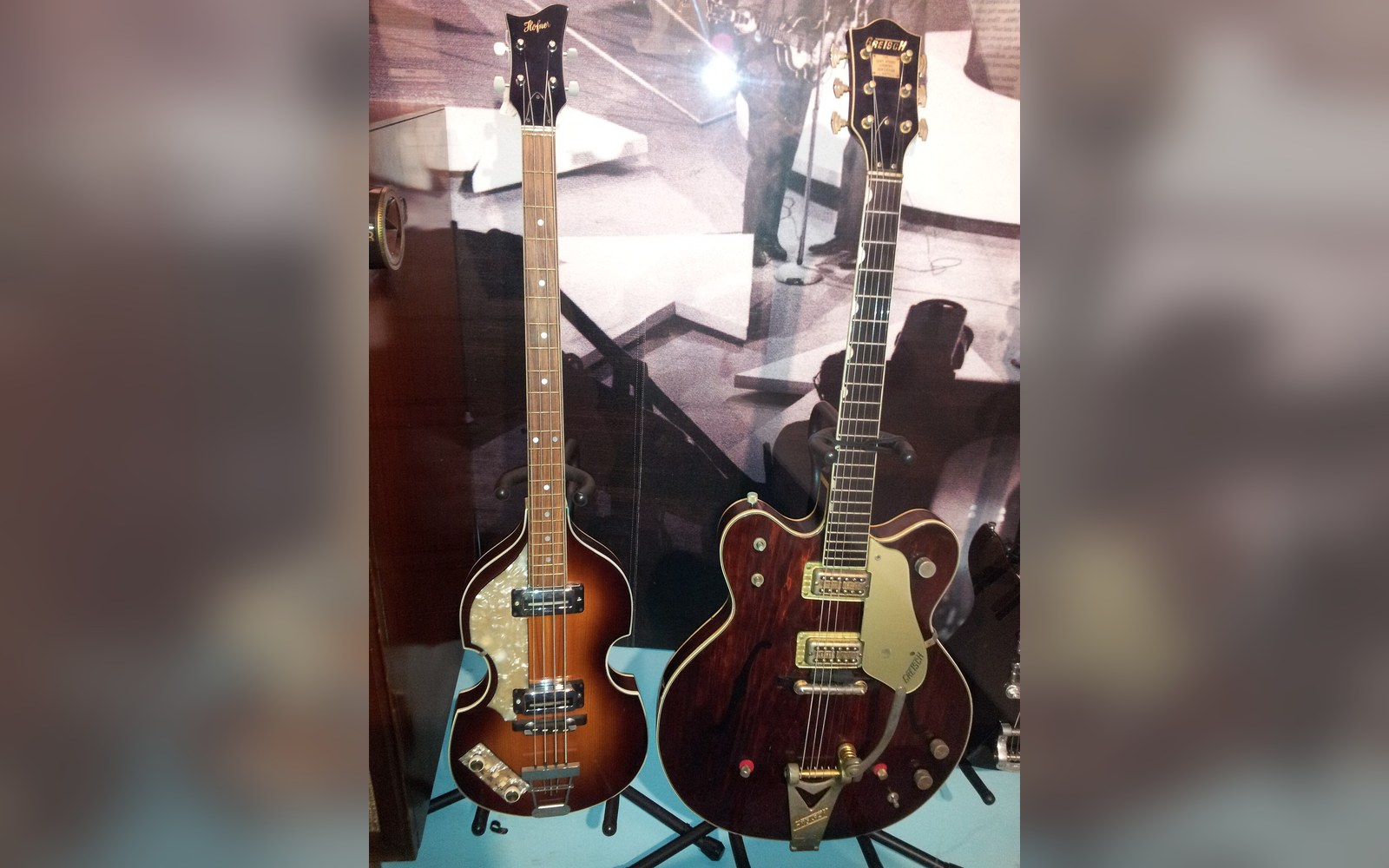
A Bass Built Like a Violin
Höfner's 500/1, introduced in 1956 and built in Bubenreuth, Germany, is constructed on a fully hollow spruce-top body shaped like a miniature double bass — symmetrical along its vertical axis in a way that a solid-body instrument never is. When Paul McCartney encountered one in Hamburg in 1961, that symmetry meant a right-handed instrument could be strung and played left-handed without looking obviously wrong. It was also considerably cheaper than a Fender. Both facts decided his career sound.
The scale length is approximately 30 inches — a short scale by any measure — which reduces string tension across the board and gives the instrument a looser, rounder feel under the fingers. The neck is a set maple neck joined to the hollow body. The two proprietary staple-style pickups — nicknamed the neck and rhythm positions — sit closer to the center of the string than a Precision's split-coil would, pulling tone from a part of the string that emphasises fundamental over harmonic content.
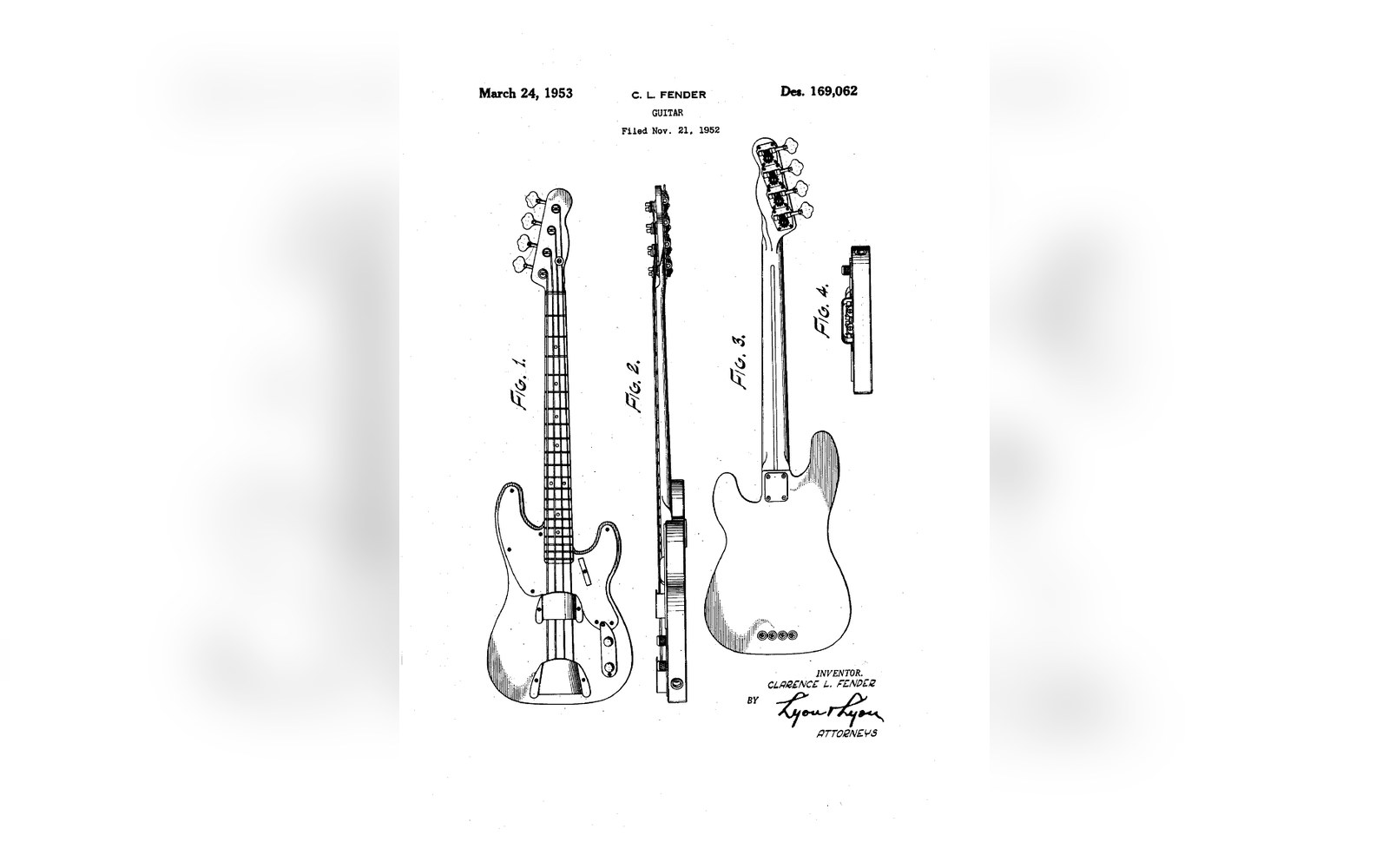
Leo Fender's design patent, filed in 1952. What it draws is the first instrument: square edges, one pickup, a headstock lifted off the Telecaster.
Photo: Fender Precision Bass '51 patent sketch (D169062) · Wikimedia Commons
The tonal consequence is not incidental. Flatwound strings, already the industry default when McCartney was recording at Abbey Road Studios, suppress the upper partials further. A hollow spruce body resonates sympathetically at low frequencies in a way mahogany or alder cannot, adding a woody bloom beneath the note. Together — short scale, hollow resonance, flatwound strings, central pickup position — the elements produce a thud with almost no attack transient and a decay that vanishes quickly. That sound sits in a mix by occupying a narrow frequency band and simply not competing with anything else.
Höfner has manufactured the 500/1 in essentially continuous production since 1955, and the contemporary Violin Bass retains the core construction. Nothing about the instrument's architecture has needed correcting.