
The Problem a Straight Fret Cannot Solve
A standard 34-inch scale bass is a compromise. Set the scale to tension a low B string correctly and the G string goes stiff and bright; optimise for the G and the B goes slack, with intonation that drifts and a fundamental that never quite locks in. For decades, most five- and six-string builders simply accepted the compromise, adding mass to the low string or raising tension through string choice.
Ralph Novak did not accept it. Working in the 1980s, Novak developed and patented a fanned-fret system in which each string runs a different speaking length — longer on the bass side of the neck, shorter on the treble. The frets, rather than running perpendicular to the strings, sit at a mild angle that varies along the neck. The Novax patent gave the approach legal form and established the licensing framework that made commercial production viable.
Dingwall's Application
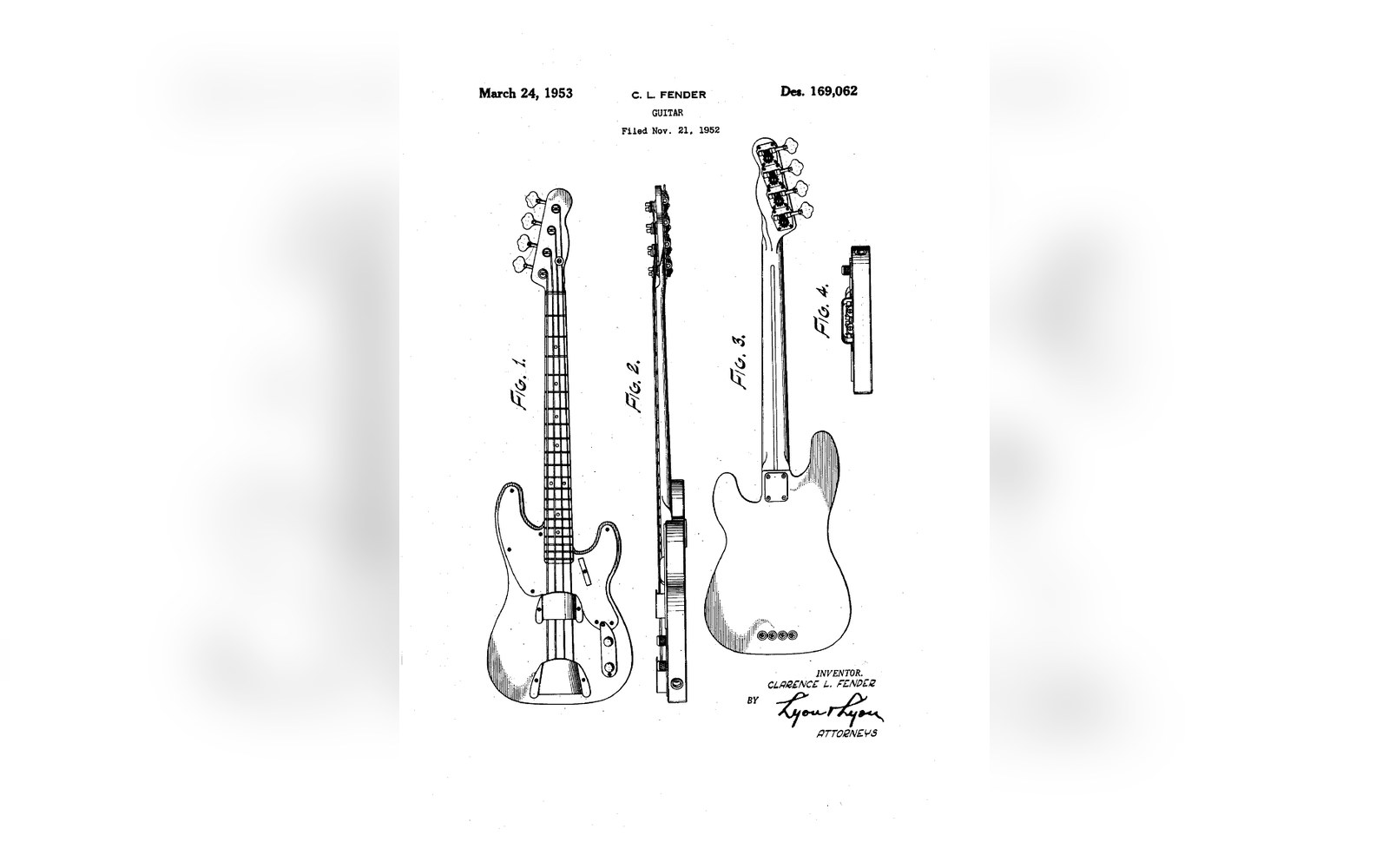
Leo Fender's design patent, filed in 1952. What it draws is the first instrument: square edges, one pickup, a headstock lifted off the Telecaster.
Photo: Fender Precision Bass '51 patent sketch (D169062) · Wikimedia Commons
Sheldon Dingwall, building in Saskatoon, Canada, licensed the Novax system and took it further into production than anyone else had managed. Dingwall instruments typically run a 37-inch scale on the low B and a 34-inch scale on the G, with the frets fanned across a spread that would look alarming on paper but sits naturally under a player's left hand once the neck is horizontal in playing position. The perpendicular point — where the frets run closest to straight — falls roughly at the seventh fret, near the centre of the hand's most frequent work.
The engineering consequence is measurable. The longer B-string scale increases tension and speaking length simultaneously, improving the overtone series and tightening the fundamental. Low notes read clearly in a mix without the processing work a slack string requires. Intonation across the neck becomes consistent in a way that a uniform-scale five-string rarely achieves without significant compensation at the bridge.
Why It Stayed Specialist
The tooling cost of fanned-fret production is real. A fanned-fret fingerboard cannot share fixtures or fretting machinery with a conventional neck; every routing template is instrument-specific. For most of the 1990s and 2000s, the approach remained the territory of boutique builders and players who had already decided that the low B string was worth solving properly.
That began to shift when Darkglass Electronics and the broader rise of modern metal and progressive rock put extended-range basses in front of wider audiences. Ibanez introduced fanned-fret production models in the mid-2010s, and by the early 2020s the format had entered the mid-market from multiple manufacturers. The argument Novak made in the 1980s had simply taken thirty years to win.